


“AI literacy” typically means a basic understanding of how to use applications like chatbots, plus a grasp of this technology’s potential and limits, alongside a sense of its possible impacts on individuals and society itself. However, the era that is unfolding demands an even broader conception of AI literacy that includes the influential but fractured discourse around this technology.
Today, most people conceive of the AI future through the lens of a few leading narratives, which filter down through mainstream news or circulate on social media. However, some of that discourse consists of caricatures, whether exaggerating the capabilities or downplaying them; poorly expressing the benefits and the risks; and distorting the trajectory of technical developments or AI adoption.
That is why I’m proposing a framework to make sense of today’s AI discourse, composed of three core dimensions that explain the underpinnings of much of what you’ll hear. It’s a way for anyone to evaluate whether evidence supports certain narratives. Also, for policymakers who wish to shift the discourse, it’s a way to understand which underlying beliefs they must address.
The three key dimensions of AI discourse are: valence (if a person judges the technology as inherently dangerous or beneficial); effectiveness (how powerful the person considers it); and trajectory (how rapidly they expect it to advance). If you plot these in quadrants, you see immediately where the leading narratives land. Moreover, you can parse any new narratives, “vetting” them with the VET (Valence/Effectiveness/Trajectory) framework.
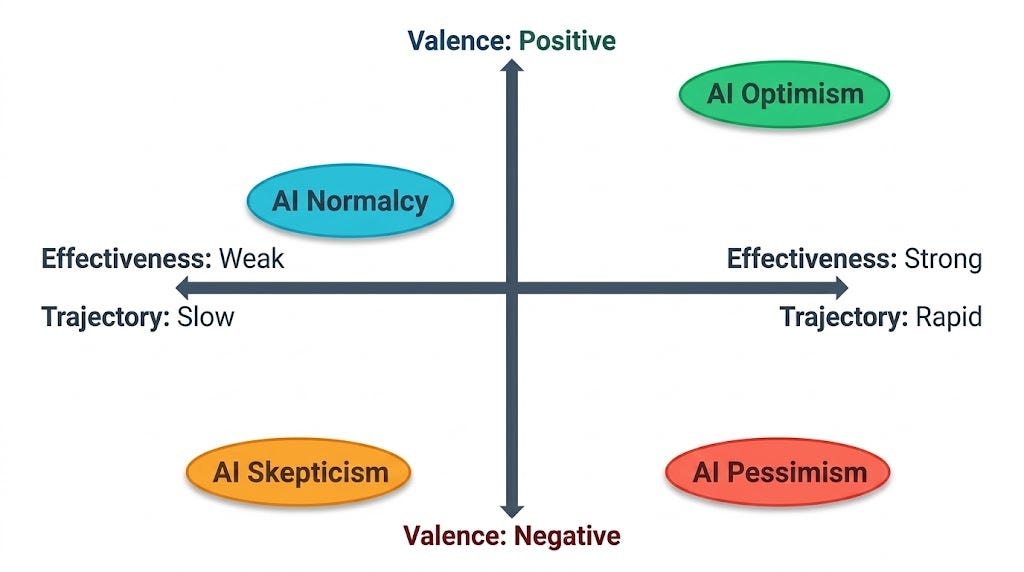
The 3 Clues to Every AI Narrative
Let’s start with valence. Negative valence is associated with concerns about potential AI harms, from the environmental impact, to job losses and deskilling, to worsening inequality for marginalized groups, and the undermining of human relationships. Conversely, positive valence is associated with predictions of accelerated scientific and medical discovery, the elimination of tedious work, the expansion of skills through human/AI collaboration, assistance for people with disabilities, and novel social support for the isolated and bereaved.
The valence that someone ascribes to AI may emerge from their existing ideological views, such as attitudes toward technology generally, privacy, capitalism, and wealth inequality. Valence may also develop from a conviction that AI could become sentient, and/or that thinking machines might seek to shape the fate of humanity.
The second key dimension in the VET framework is effectiveness. This represents a person’s view of AI capabilities, including accuracy and reliability. Often, these views contrast AI with human abilities—such as the claim that AI could never really be as smart as people are, or that the technology is hurtling toward a turning point at which it matches or surpasses human cognitive powers across nearly all tasks, known as artificial general intelligence, AGI.
The third dimension, trajectory, moves past attitudes about what AI can do to predictions about when. Such views depend on estimates of technical progress—for instance, how near or far we are to AGI, or to humanoid robots with human-level dexterity. This dimension also encompasses predictions about AI usage, and whether individuals, corporations, and governments will incorporate the technology quickly, or if learning curves, regulation, social resistance, or other factors may delay them.
Different combinations of valence, effectiveness, and trajectory cohere into common narratives about AI. But how exactly does this manifest?
AI Optimism
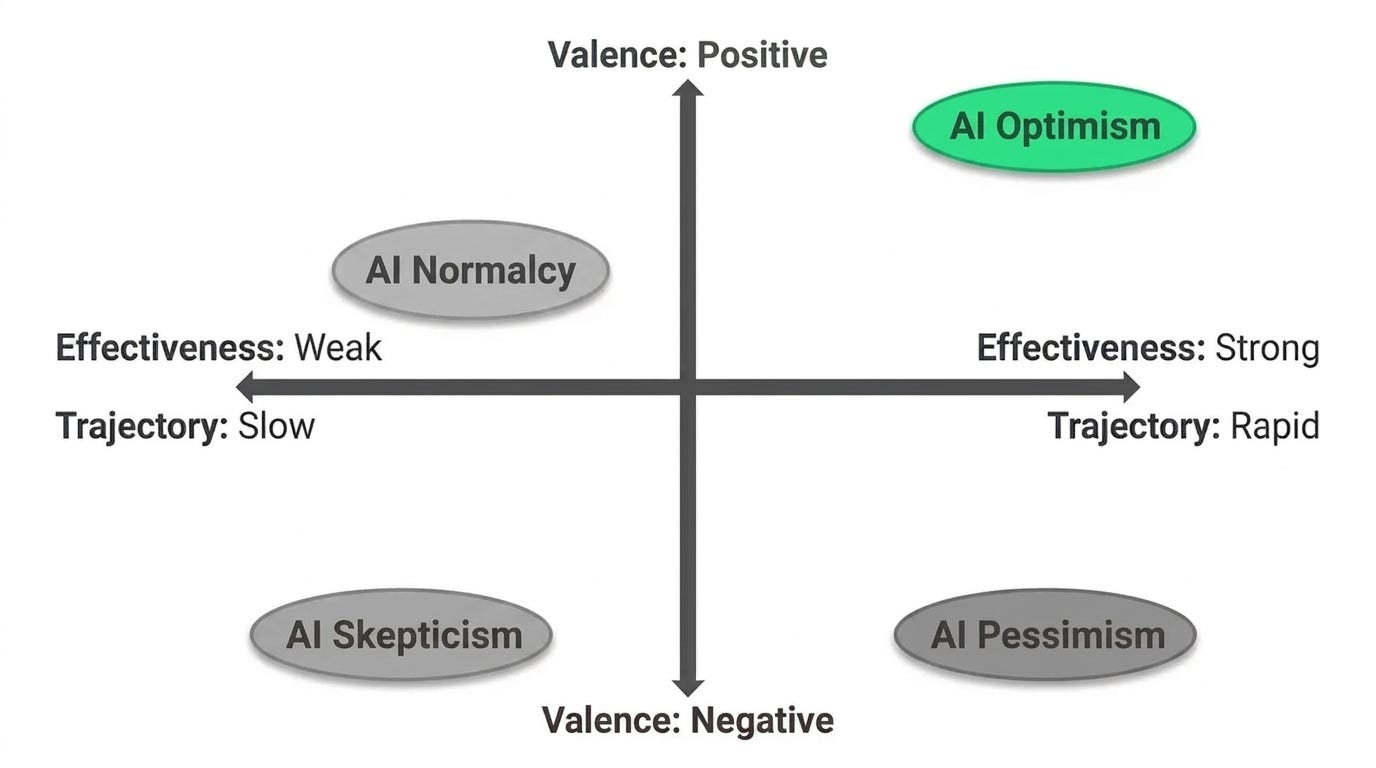
In its strongest form, this narrative portrays AI as a technology likely to be transformative in the short-term, ushering in a utopian era of harmony and leisure while also helping address society’s ills, cure diseases, and create prosperity for all. Break this down into the components of VET and you find: positive valence combined with strong effectiveness and rapid trajectory.
AI Optimism narratives often come from startup founders and investors who stand to gain should their visions come true, with an entire genre of manifestos devoted to such visions, from Marc Andreessen’s blog post “The Techno-Optimist Manifesto” (2023) to Dario Amodei’s essay “Machines of Loving Grace” (2024) to Sam Altman’s “The Gentle Singularity” (2025) to Mark Zuckerberg’s “The Future Is for Everyone” (2026). Elon Musk has likewise predicted radical societal change, forecasting that AI and robotics will render work irrelevant within a decade or so.
An argument in favor of AI Optimism is that these technologies are already demonstrating astonishing results, as with recent breakthroughs in mathematics, and that many human systems are currently struggling to make comparably fast progress. By this logic, failing to push ahead with AI as fast as possible is itself a form of harm, given how many intractable problems remain, from cruel illnesses to climate change.
But AI Optimism narratives can also affect public expectations, stirring impatience over the technology’s failure to yet solve humanity’s problems. Chip shortages and the need for power and data-center infrastructure may slow adoption—even more so in the Global South. National security concerns may cause governments to limit access to powerful AI. Above all, many of humanity’s problems are not just technological, but have social elements. The invention of new mRNA vaccines for Covid did not “solve” the pandemic, given that some people chose not to take it, and others—especially in poorer countries—could not access it.
Narratives that present AI as having universally positive impacts also make it less likely that societies critique the coming technology and mitigate harms. In this way, the optimism narrative risks overreliance on AI, the formation of parasocial emotional relationships, and possibly even the view of this technology as a form of superhuman deity. Characterizing AIs as “geniuses” also obscures the spikes and valleys in their current abilities, potentially misleading users to generalize from systems’ strong performance in some areas to others in which they are less skilled.
AI Optimism narratives also tend to overlook how much adoption may lag behind technological capabilities. By way of example, large-scale rollout of self-driving vehicles has been slower than many predicted, even though the technology has outperformed human drivers in safety. Yet public skepticism, misunderstandings about their safety, as well as regulatory challenges, have slowed deployment.
AI Pessimism

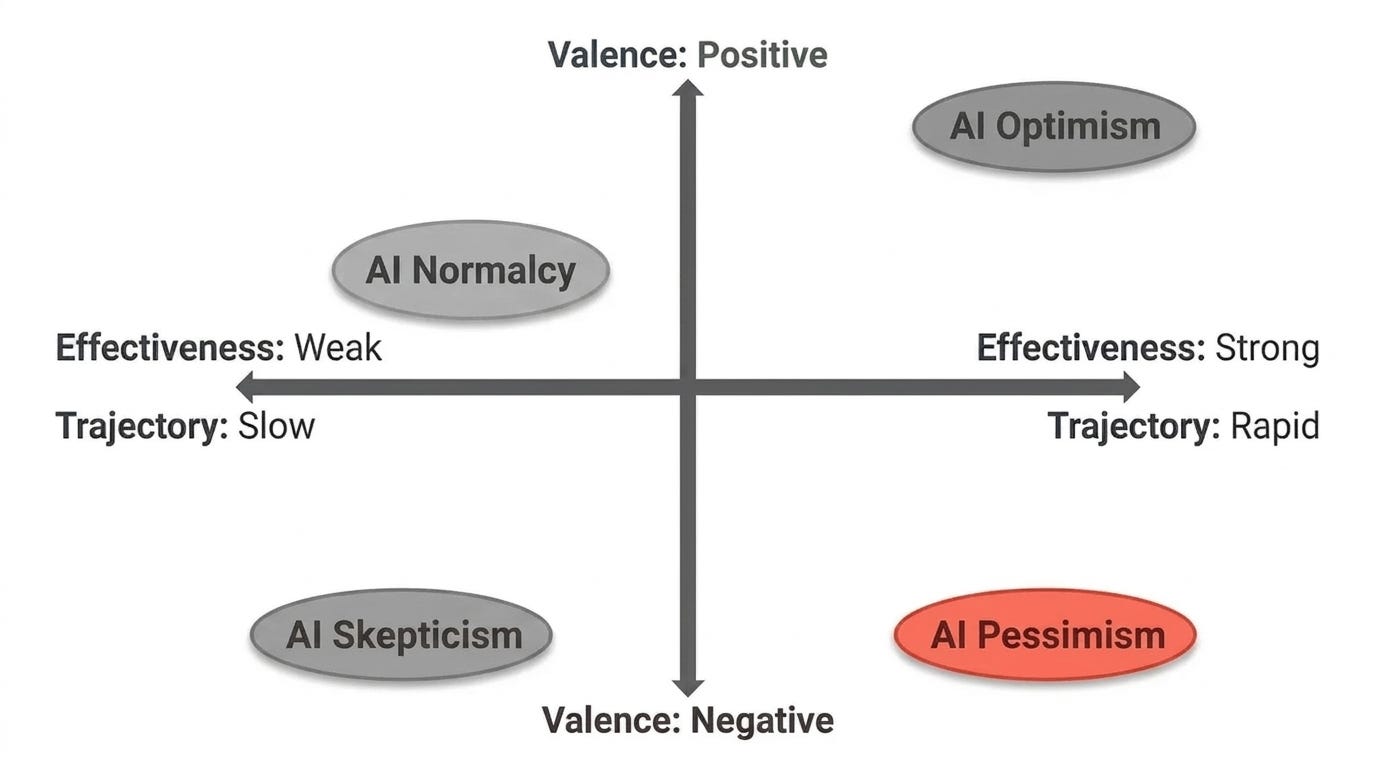
The opposing narrative, AI Pessimism, shares two of the three underlying VET dimensions with AI Optimism: strong effectiveness and rapid trajectory. Yet it reverses valence from positive to negative. This helps explain why the Silicon Valley discourse tends to be polarized between these extremes: both sides share faith in an imminent tech transformation; they just dispute whether the outcomes will be justifiably beneficial to unjustifiably risky.
Portrayals of AI Pessimism in the media tend to focus on vivid catastrophes that could threaten human existence itself, known as “X-risks.” Such scenarios commonly envisage a superintelligent AI system or rogue AI agents unaligned with human values. However, the hypothesized harms may also involve human misuse of powerful AI—for instance, to design and deploy deadly weapons or commit cybercrimes.
An argument in favor of AI Pessimism is that long-imagined scenarios regarding intelligent systems breaking rules and laws in the real world are already upon us, as in the recent cases of agents running amok. And such systems are only becoming more capable. The argument for advocating AI Pessimism is that the private companies and nation-states creating these systems have powerful financial incentives that may blind them to the perils.
A leading proponent of such narratives is Eliezer Yudkowsky, founder of the Machine Intelligence Research Institute, MIRI, and co-author of the 2025 book If Anyone Builds it, Everyone Dies, in which he guessed that the probability of humanity’s doom—his “p(doom),” as it’s known in AI circles—is nearly 100%. The Oxford philosopher Nick Bostrom popularized the use of thought-experiments to conjure hypothetical AI disasters in his 2014 book, Superintelligence, which famously imagines a “paperclip maximizer” AI whose quest to harvest all planetary resources to create paperclips ends up destroying humanity.
In 2023, many prominent scientists and entrepreneurs endorsed a public statement asserting that, “Mitigating the risk of extinction from AI should be a global priority alongside other societal-scale risks such as pandemics and nuclear war.”
Many signatories did not wholly endorse AI Pessimism, but rather hoped to signal to policymakers that there was a risk of serious harms. This makes the point that any given person, or group, may land on different points of the VET framework, depending on what aspect of AI they’re considering—perhaps heartily optimistic about AI for drug discovery but utterly pessimistic about AI for education. This said, distinct narratives do exist, and media coverage often amplifies the negative valence and fast trajectory angle, stating that credible authorities believe human extinction might be near.
Such narratives may lead the public to both overestimate the capabilities of AI and the likelihood of extremely low-probability events. The risk is a backlash against AI that blocks beneficial technologies, such as safe applications of AI to medicine, science, and cybersecurity. In extreme cases, pessimistic narratives might endanger those working on AI by inspiring members of the public to take violent action to mitigate hypothesized risks, as in the case of an individual who attacked Altman’s home in early 2026.
A complaint about the X-risk versions of the AI Pessimism narrative is that these divert attention and resources from more pressing impacts, such as how this technology affects interpersonal relationships, education, jobs, the environment, and geopolitics. However, evidence suggests that the narratives about existential risk do not lower public concern regarding other possible dangers.
Paradoxically, AI Pessimism narratives may lead people to overtrust AI outputs, because these narratives often characterize AI as being superhuman. Additionally, such narratives commonly imply that current or future AIs may develop malign goals of their own, which encourages the public to ascribe consciousness to such systems, even when current scientific consensus does not support this.
AI Skepticism
AI Skepticism narratives share the pessimists’ negative valence for AI. But they dismiss the Silicon Valley view of the power and speed of this technology, believing in low effectiveness and slow trajectory. The skeptical narrative argues that AI technologies, particularly those based on large language models, can never be intelligent in the way humans are, and therefore will never fulfill their developers’ lofty promises.
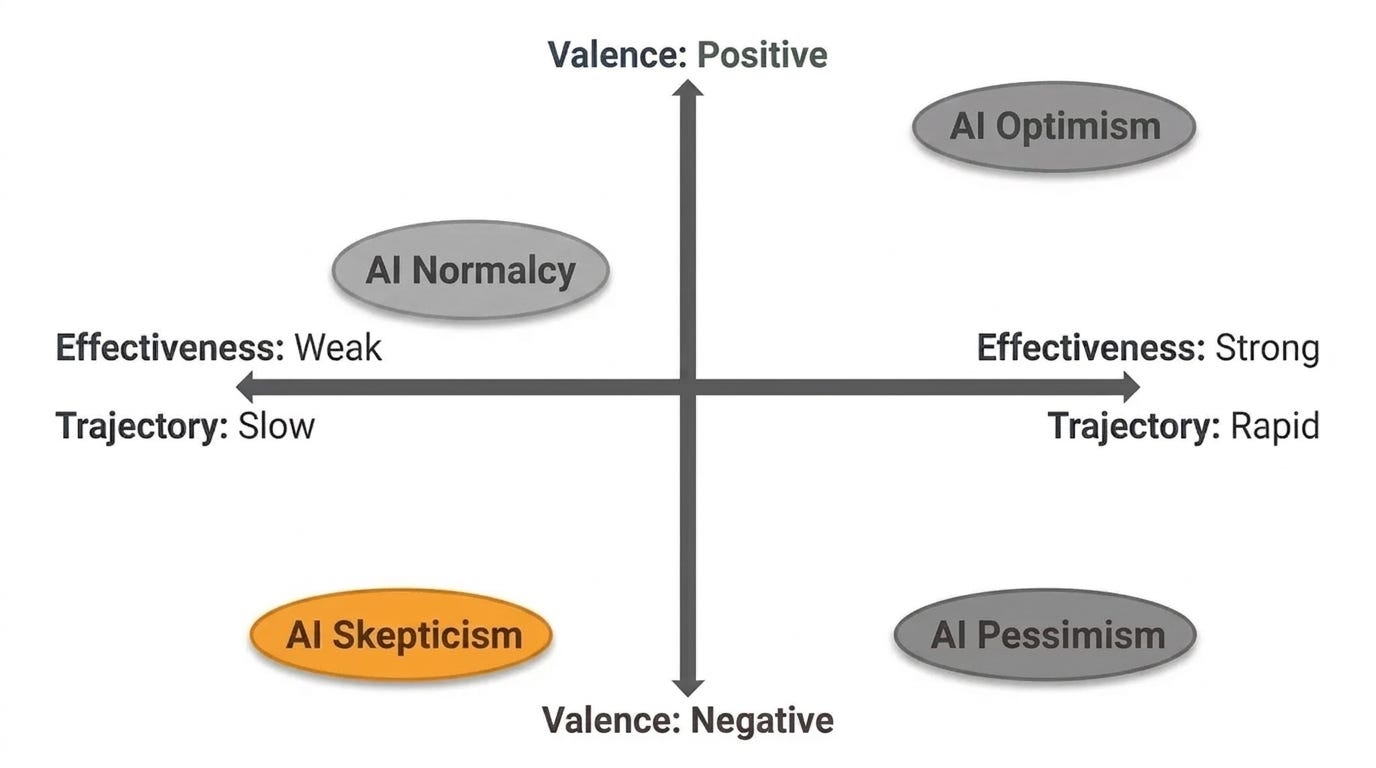
One branch of AI Skepticism argues that the very weakness of this technology is what will make it so societally disruptive, with companies replacing human labor with error-prone AI to eliminate costs, only to wipe out human skills in the process. Related to this is the dread that AI may widen the gulf between the favored and the marginalized, with faulty automated systems enforcing the bias embedded in data, enforcing the unfair treatment of the historically excluded and oppressed.
Among the arguments in favor of AI Skepticism is that, despite the widespread adoption of chatbots and the early application of agentic systems, stark benefits remain hard to find in the economic data. Nor has the talk about “solving” disease and other immense human problems shown results that the public can readily experience. Others worry that the promise of AI handling any difficulty that people face could end up deskilling individuals, as with fears of students offloading their learning to machines.
Resentment over social media and large technology companies often underpins AI Skepticism. This lingering cynicism echoes in the resistance to data centers. “It’s going to be this drone of a building that makes an odd sound all the time and sucks up all the electricity and could poison my water. Okay, what’s the trade-off?” one campaigning U.S. politician lamented, as reported by the journalist Jasmine Sun. “The buildout of an industry that everyone’s telling me is going to come for my job. So what is the upside? Well, you can ask meaningless questions and queries to your ChatGPT.”
A notable expression of the AI Skepticism narrative came in a 2025 book by the linguist Emily Bender and the sociologist Alex Hanna, The AI Con, which contends that such technology can never recreate the richness of human intellect, and that modern AI systems are mere “stochastic parrots,” presenting an illusion of knowledge via fluent text with no true understanding. They argue that the term “artificial intelligence” is deliberately misleading, and propose tongue-in-cheek alternatives, such as “synthetic text-extruding machines” and “racist pile of linear algebra.”
Another representative of the AI Skepticism viewpoint is Gary Marcus, an emeritus professor of psychology and neural technologies at New York University, who likewise has said that today’s AI systems—if not a scam—have been sold in misleading ways. His judgments of weak effectiveness and slow trajectory regard the current technical approach underpinning generative AI.
However, the AI Skepticism narrative of weak effectiveness bypasses evidence of AI’s utility, indicated by the astonishingly fast adoption of generative AI tools and the growing value that users ascribe to them. Contemporary AI has transformed the coding industry, contributed to scientific advances, and novel solutions to longstanding challenges in mathematics. AI also supports analysis of medical data and imagery, and is able to identify cybersecurity vulnerabilities that human experts could not find.
AI Skepticism often suggests that society should not adopt AI because of its flaws. However, a logical threshold for deployment in many cases need not be perfection, but comparison with current levels of error and expense. If an AI-diagnosis system makes mistakes—but fewer than human doctors, and at a fraction of the cost—this could provide a net benefit. Helping the public understand the tradeoffs inherent in policymaking is a critical component of AI literacy that skepticism narratives obscure.
AI Normalcy
This narrative argues that today’s AI is akin to past technological innovations that have considerably affected society but not suddenly overhauled it, and therefore there is no need for urgent preparation. Unlike the other three narratives cited, AI Normalcy is not at the extremes of the three discourse dimensions. Indeed, moderation defines this stance, which characterizes AI as having a neutral-to-positive valence and moderate effectiveness—but with a relatively slow trajectory.
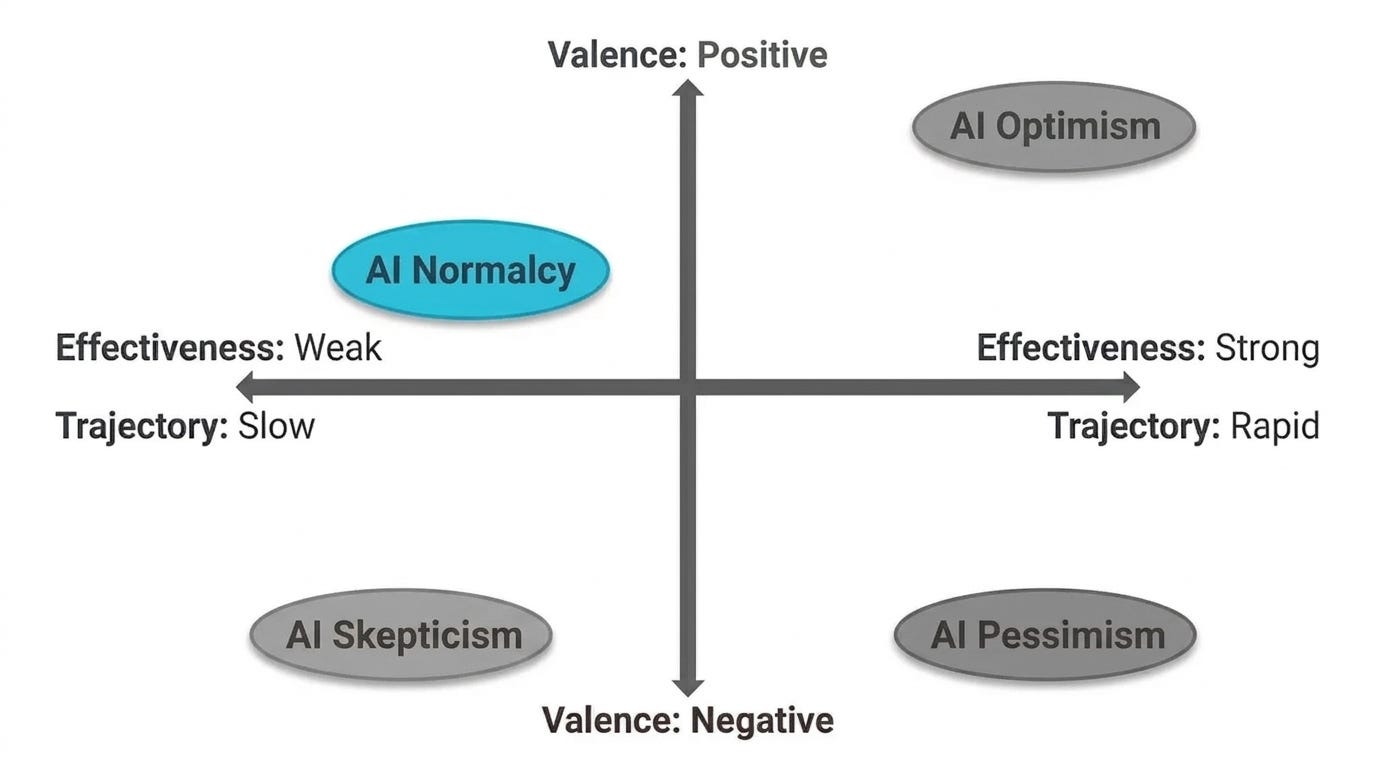
The most prominent example is the 2025 essay “AI as Normal Technology,” by the Princeton computer scientists Arvind Narayanan and Sayash Kapoor, that equates modern AI with electricity and personal computers, both of which required decades for mass adoption and to demonstrate concrete productivity gains. A core distinction is that the AI Skeptic argues that this technology will never achieve its most lofty (or most frightening) claims, while the AI Normalist thinks that AI may eventually be transformative.
Typical of this is the MIT roboticist Rodney Brooks, who argues that short-term predictions about technological impacts tend to be overblown, whereas long-term adoption and uses over the decades can be unanticipated.
Several economists have contributed to this view, with David Autor and others contending that job losses will be offset by gains from new classes of AI-enabled jobs, as has been the pattern with past technologies. (However, many leading economists, including Autor, recently signed a demand that policymakers safeguard society against radical economic transformation from AI, suggesting that they may have updated their views on trajectory, judging it faster than Normalcy narratives suggest.)
Other economic expressions of AI Normalcy include citations of the Jevons Paradox—that technology’s efficiency in generating a resource may not just quench demand, instead stirring greater demand—to argue that AI could trigger new roles for human labor.
The VET framework also suggests why AI Normalcy narratives are less prevalent than AI Optimism, AI Pessimism, or AI Skepticism: traditional news coverage and social media alike tend to amplify more extreme narratives, especially those with negative valence.
But if AI Normalcy’s moderation in the trajectory dimension proves wrongheaded, it risks lulling policymakers and the public into complacency, leaving them with less time to prepare and adapt, whether that’s governments pursuing policies and regulation, or individuals re-skilling.
Conclusion

The VET framework doesn’t claim to assert the correct combination of valence, effectiveness, and trajectory. Partly, this is because AI is changing so quickly, making the technology and its impacts a moving target. Releases of new models, not to mention agentic harnesses, may justify updates to how to evaluate effectiveness; changes in regulation might alter adoption trajectories; and cybersecurity incidents might prompt people to revise the valence they attribute to AI.
This dynamic future is exactly why VET is relevant, offering a structure with which to critically reflect as new information lands. Fresh narratives will arise. Much will be contested. AI literacy will become all the more vital for both the public and the policymaker.
But AI literacy is more than knowing how to use a chatbot or an agent; it’s more than awareness of deep-fakes; it’s more than pondering human-bot relationships. We face a range of possible AI futures, and a range of narratives. AI literacy demands clarity about what you’re hearing.
Meredith Ringel Morris developed the VET framework in her capacity as an affiliate faculty member at the University of Washington, thanks to the generous support of an academic writing fellowship hosted by Paris IAS.
By the same contributor


This is tremendously helpful, thankyou. It challenges the polarising "pro/con" arguments that characterise much discussion around this theme.