

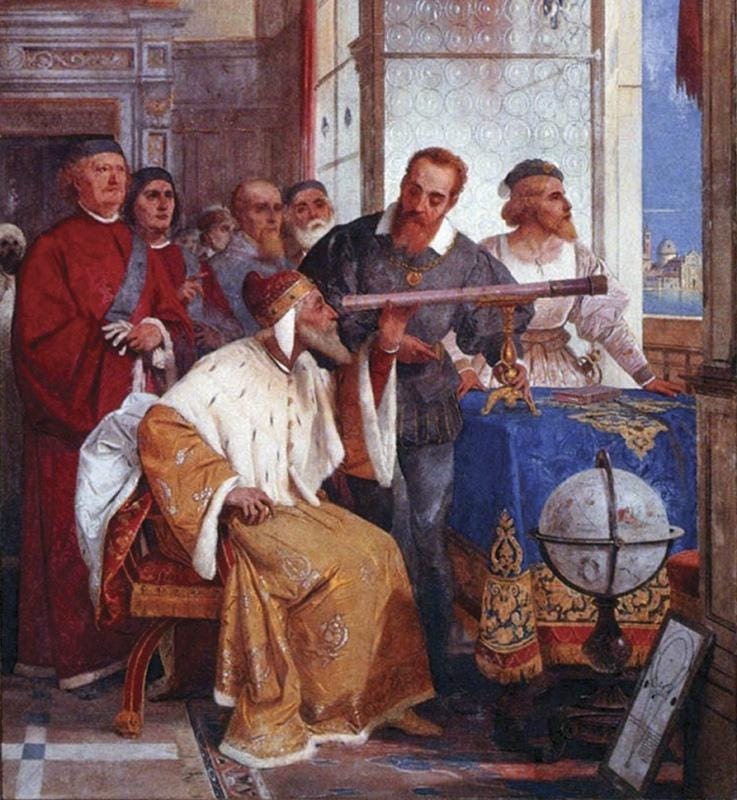
In 1610, Galileo gazed into the night, peering through a wooden tube encased in red leather. In that black heaven, dots of light caught the Italian’s eye: moons going around Jupiter. And he had it—evidence that not every celestial body orbited the Earth. Copernicus had been right!
Galileo is recalled as a giant of science for such epiphanies. Yet he would have seen little of the night sky, were it not for that magnifying cylinder in his hands, the telescope.
Later that century, the English polymath Robert Hooke and the Dutch autodidact Antoni van Leeuwenhoek would point their magnifiers downwards, observing hitherto invisible cells, bacteria and spermatozoa. Armed with microscopes, they laid the groundwork for subsequent life-saving breakthroughs, such as the germ theory of disease.
The visionaries peeping through ground-glass lenses or pointing lasers are remembered as the heroes of progress. But, according to a new book by the metascientist Alexander Krauss, that view is askew. What drove the Scientific Revolution in the 17th century—and what may propel scientific discovery in this age of AI—is not the grand theorist, but the grand tool.
In The Engine of Scientific Discovery, Krauss—a researcher at the London School of Economics—subverts many classic narratives around scientific discovery. For instance, big advances weren’t a matter of paradigm shifts that overhauled everyone’s views in a flash. Nor were famed findings a matter of chance. Nor should we credit the scientific method for everything. Studying more than 700 notable discoveries, Krauss contends that the common thread sewing our revelations together was the presence of new tools and methods.
“Tools” are physical instruments, like lasers and X-ray devices, that help us observe and measure the world. “Methods” are techniques, like controlled experimentation, that tell us how to reliably gather and interpret this data.1 What they share is the power to extend our limited senses, transforming how far we can see, think, and explore.
Certain tools, like the telescope, enhance our existing senses. Others, such as the X-ray machine, capture signals we could never otherwise perceive. New tools lead to new observations—DNA’s double-helix or an echo of the big bang—that serve as discoveries in their own right or prompts in search of new explanations.
Krauss’s book has implications for how researchers—and funders of science, both public and private—should think about their pursuits, particularly with the growing place of artificial intelligence in scientific discovery. Is the ultimate power of AI that it may upgrade our senses again? If so, what current tools might it improve, and which might it design from scratch?
A Dataset of Discovery
Over the past 30 years, the number of full-time researchers has more than doubled, to more than 9 million. But our understanding of how scientific discovery happens has not kept pace. This comes at a cost: if you can’t understand a process, how can you control and accelerate it?2
To tackle this question, Krauss compiled a dataset of 761 of the biggest discoveries up to 2022, including all Nobel Prize winners, as well as breakthroughs from fields that the Nobel overlooks, such as computer science. Krauss read each original publication to understand the context surrounding the breakthroughs, the attributes of the scientists involved, and the tools used.
He found that almost all the discoveries were made possible by a recently developed tool or method. The average gap between a new tool’s development, and a subsequent breakthrough stemming from it, fell from several decades in earlier centuries to a few years today. Krauss attributes much of this drop—particularly in biology and medicine—to the faster generation and analysis of data that imaging tools, computers, and now AI, enable.
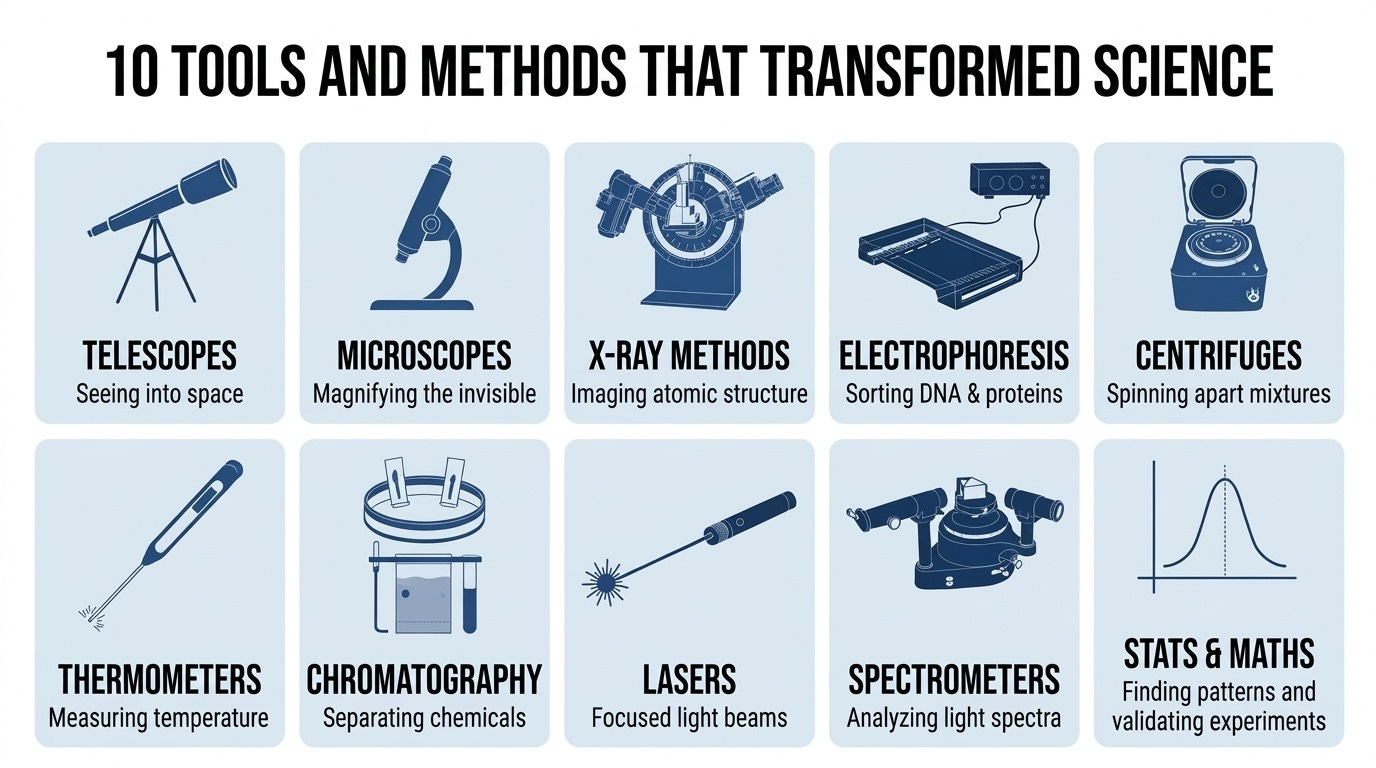
Ten tools and methods contributed the most, in part because toolmakers have continually upgraded them. By the 19th century, the optical microscope had run into the laws of physics, unable to distinguish details closer than ~200 nanometers together, which is far larger than atoms, proteins, and most viruses. Happily, the discovery of the electron (itself the result of an improved scientific tool, the cathode ray tube) and its short wavelengths led a 26-year-old German graduate student, Ernst Ruska, to pioneer the first electron microscope in 1933.
This new kind of microscope sparked a range of novel observations, such as the inner structural components of cells, the arrangements of atoms in metals, and the first clear images of viruses, taken by Ernst’s younger brother, Helmut. The electron microscope also illustrates two of Krauss’s other findings: many scientific tools get adopted well beyond the domain where they were first applied, and breakthroughs often happen when scientists bring multiple tools together.
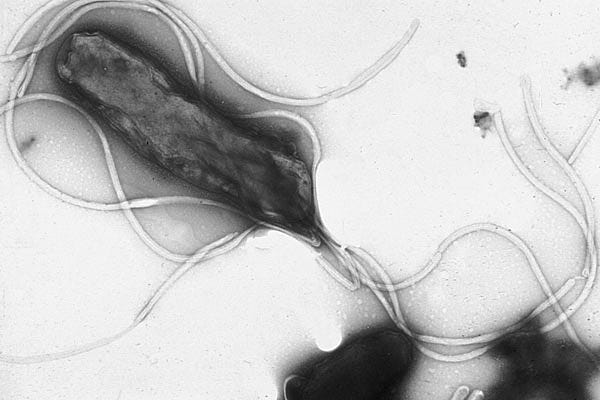
An example came in the late 1970s. Back then, medical wisdom held that stomach ulcers were triggered by stress, genes, and spicy food. This changed when the Australian pathologist Robin Warren and his research partner Barry Marshall identified an offending bacterium—H. pylori—in routine stomach biopsies. To convince skeptics, adamant that bacteria could not survive the rigors of stomach acid, Marshall would later drink a beaker of H. pylori, become violently ill, and treat himself with a swift course of antibiotics.
So, what were the tools and methods here, beyond Marshall’s intrepidity? The breakthrough owed much to fiberoptic endoscopes, which are long flexible tubes that allow doctors to view an ulcer and take a snip from the tissue; the agar culturing method that Warren and Marshall used to grow the bacteria; and the electron microscope that they used to characterize them.

Shifting the Paradigm
How we understand science—and how we fund it—is wrong, Krauss argues. First, he takes on the American historian Thomas Kuhn’s influential 1962 book The Structure of Scientific Revolutions, which argued that science proceeds when a “paradigm” shift occurs, that invalidates earlier views and redefines the questions judged worth studying. The success of Kuhn’s concept turned this niche grammatical term, “paradigm”, into a buzzword that business leaders and government officials have cited ever since.
However, Kuhn based that book on just a handful of case studies, especially from the physical sciences where he had once trained. In reality, Krauss contends, science does not radically switch perspectives; it is built steadily. Of the 761 discoveries in his dataset, only 1% have been discarded, such as Italian scientist Luigi Galvani’s claim in 1791 that frogs secrete “animal electricity”. And even that idea ultimately led Alessandro Volta—who disproved it—to create the battery, a cumulation of sorts.

Krauss also looks at the oft-repeated notion that scientific discovery is reliant on chance, and impervious to explanation altogether.3 While luck may contribute to who makes a finding, Krauss argues that a new tool or method ensures that somebody will. So, when a young engineer, Koichi Tanaka, grabbed a bottle of glycerin instead of acetone during an experiment in the late 1980s, and inadvertently invented a new way to analyze complex proteins, for which he would later share a Nobel Prize, it was new tools—such as the computer software used to detect the protein—that made such a discovery inevitable.4 This is also why scientists often independently converge on the same breakthroughs, which the sociologist Robert Merton once argued was the dominant version of how scientific discovery happens, rather than the exception.
Finally, Krauss targets the scientific method, the closest thing that the research community has to a shared faith in how discovery happens. Textbooks and major funders continue to describe the method as a neat set of sequential steps, running from observation, to hypothesis generation, to testing.
But almost one-third of the 761 discoveries in Krauss’s dataset violated that sequence. The discovery of X-rays and H. pylori bacteria didn’t require any pre-existing hypothesis. Scientists transformed our understanding of faraway planets without being able to run experiments on them. The three steps may apply more often than not, but they describe a kind of reasoning that is also present elsewhere, from detective work to plumbing.5 What distinguishes scientific discovery, Krauss argues, is the use of specialized tools and methods, and he proposes updating the scientific method to explicitly capture this.
A core argument in Krauss’s book is that science persistently disregards toolmaking, and at a cost. When the British biochemists Archer Martin and Richard Synge developed a method that allowed scientists to separate chemical mixtures in 1941, they weren’t using newfangled technology to do so. Partition chromatography required only water, filter paper, and solvent—all standard lab supplies. It subsequently enabled 13 Nobel Prize-winning discoveries, such as determining the sequence of amino acids that constitute insulin. “Had people’s minds been directed that way,” Martin said, “the method would have flourished perhaps a century earlier”.
How could we accelerate the next partition chromatography? Krauss recommends more grants and fellowships for toolmakers; reforming citation practices to better track the tools that scientists use, rather than just the papers they cite; and creating new ‘Methods Labs’ for scientists and engineers to jointly develop the next generation of tools.
This recommendation comes at an opportune time. While government budgets for science are under stress, considerable AI-related funding is being pumped in. Among the key players are philanthropists who are frustrated with top-down, university-led research, and are founding new kinds of research organizations. Might Methods Labs be one answer?
4 Possible Issues with the “Tools” Case
Policymakers and research funders ought to ponder Krauss’s proposals, which challenge common presumptions about science. But for a theory like his to be truly useful, it must not just help us understand past breakthroughs, but predict where future ones will arise, and how to accelerate them. Here are four potential pushbacks.
1. A Bias towards Successes
It’s likely that many big discoveries were predated by new tools. But if we were to invert it, and analyze all tools and methods ever developed, presumably most have failed. This bias could affect the viability of the Methods Labs idea, or how to best design it.
For example, one reading of Krauss’s book is that we should invite more amateurs—like the Dutch spectacle makers Hans Lipperhey and Zacharias Janssen, who allegedly created the first telescope and microscope—to create new tools for science. Another read is that there might be a lot of simple tools out there—like partition chromatography—waiting to be found. But in modern, specialized science, most amateurs will presumably struggle to contribute. And most future tools will likely be complex upgrades, rather than new simple formulations.6 If that’s right, rather than dedicated new institutions, the best path may be to incentivize current researchers, who rub up against the limitations of tools every day, to design and maintain better ones, and to encourage them to see tool-making, rather than paper writing, as a viable career path.
2. Overlooking the Importance of Data
Krauss rightly complains about the neglect that toolmakers have faced. But the oversights arguably go further, encompassing the wider infrastructure that science relies upon, particularly high-quality databases. New tools may generate new data, but that alone doesn’t make the data usable. This demands expert curation and maintenance.
AI has made that ever more clear. Deep learning owes its success not only to the vast trove of online data, but its curation into useful forms, both for training leading models and to evaluate them. Recent AI breakthroughs in predicting weather owe much to data built up over decades, by organizations like the European Centre for Medium-Range Weather Forecasts. Likewise, AlphaFold—an AI system from Google DeepMind that solved a longstanding challenge in biology—relied on the Protein Data Bank.
But, unlike toolmakers, no database developer has yet won a Nobel Prize.
3. Relegating the Role of Thinkers
Krauss ascribes much of the credit for Einstein’s theory of relativity to earlier tools and methods, such as the interferometer used to split a beam of light into two paths before recombining them, which revealed that the speed of light was constant, irrespective of the Earth’s motion. He cites with skepticism the physicist’s tale of imagining himself chasing a beam of light at age 16, and thereby realizing a contradiction in Newtonian mechanics.
This account may indeed have been fanciful. But Krauss’s argument that scientific creativity originates outside the mind, when new tools extend what humans can visualize and reason about, may relegate the very real role that human imagination has played in driving science forward. By all accounts, the Indian maths prodigy Srinivasa Ramanujan really did see his breakthroughs in his dreams. Nikola Tesla really was endowed with such an extraordinarily intense imagination that he was able to visualize an alternating current motor before implementing it in the physical world.7
Certainly, you could argue that someone else could’ve made Einstein’s discovery of special relativity in 1905, when such thinking was perhaps “in the air”. But it’s less clear that his discovery of general relativity 10 years later was. That appears to owe much to what Einstein called the “happiest thought of my life”, when he imagined what it would feel like to fall freely from a roof—a thought experiment that, he claimed, led to his Equivalence Principle, which in turn formed the basis of general relativity.
One argument for the importance of such conceptual leaps came in a recent paper from Google DeepMind researcher Tom Zahavy, which argued that frontier AI models are (currently) unable to do what Einstein did—that is, in the absence of data, they are unable to propose foundational axioms or conceptual frameworks, because they lack the real-world grounding that enabled the physicist to imagine himself falling freely from a roof.
4. Mistaking the Messy Back-and-Forth of Science for a Steady Advance
Science rarely proceeds as a single, causal chain. In their 2021 book, The Genesis of Technoscientific Revolutions, the physicist Venkatesh Narayanamurti and materials scientist Jeffrey Tsao instead described a messy back-and-forth. Science provides explanations and understanding, while technology provides the tools that science needs. Technology can precede science, in the way that Krauss argues, but science can also precede technology.8
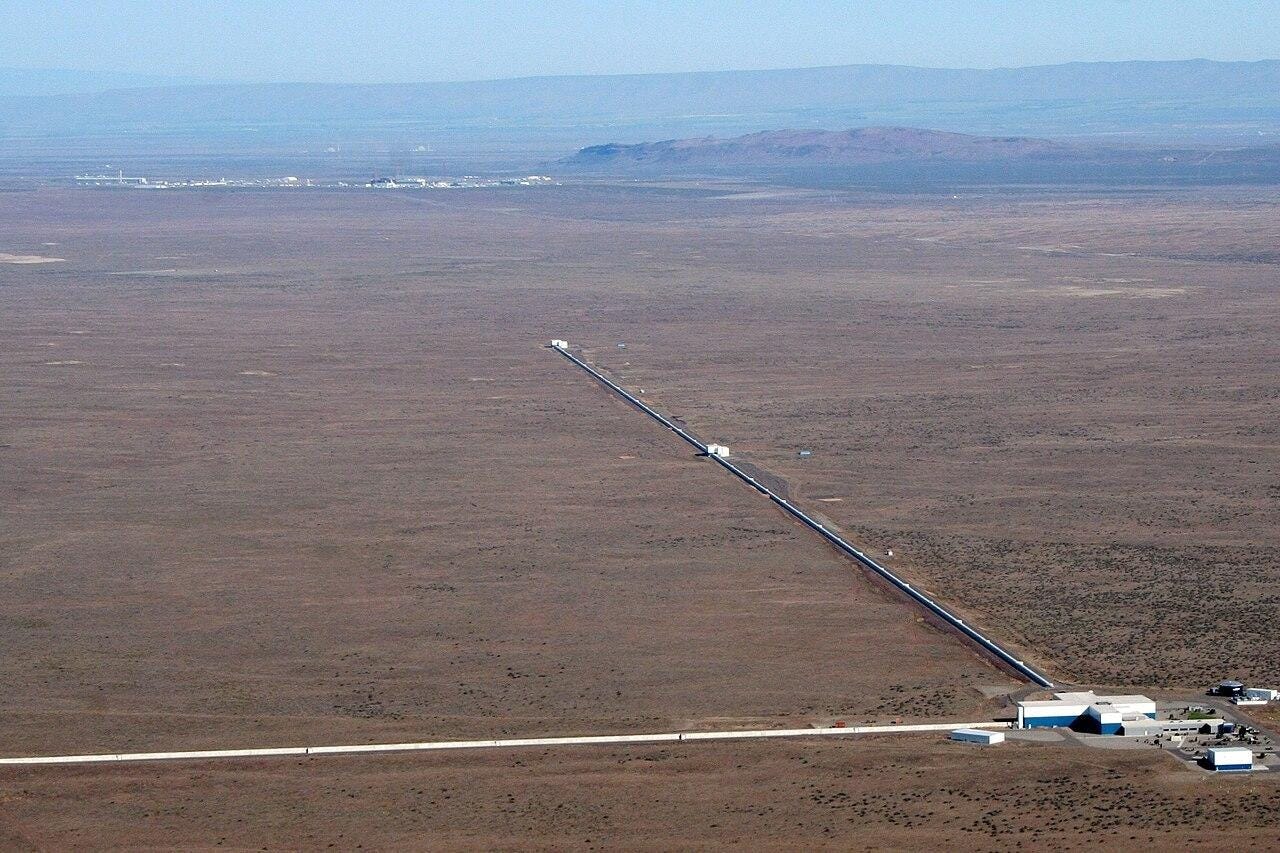
In 1916, just after finishing general relativity, Einstein predicted gravitational waves from pure maths. Yet the idea (and the Nobel Prize) had to wait another century until physicists engineered the massive Laser Interferometer Gravitational-Wave Observatory to detect those waves. Most often, rather than tools leading to theories, or theories leading to tools, there is lots of back and forth as the two co-evolve.
The history of AI highlights this messy recursion. Recent breakthroughs owe much to a mix of ever more powerful tools, such as GPUs, as well as older, simpler, methods such as matrix multiplication. But it also derives from a productive feedback loop with provocative ideas and questions, such as Ada Lovelace’s musing way back in 1843 about whether Charles Babbage’s Analytical Engine might one day compose music rather than simply crunching numbers.

AI for Tools
Despite those pushbacks, Krauss makes a convincing point that science should elevate the lowly tool. For AI advocates, the book is simultaneously heartening and worrying. As a general-purpose tool and method, AI is almost certain to significantly accelerate scientific discovery. However, our long-standing failure to invest in tools means that we may also lack the instruments and methods to generate the data that AI needs or to validate the hypotheses that it generates.
This conundrum raises a question: How could AI design and refine the tools of tomorrow?
Here are three possible ways:
1. Upgrading Tools and Methods
AI is already succeeding in this. Consider AlphaEvolve, an agentic system that takes algorithms, such as those used to sequence DNA, and designs improved versions. Or consider the computer simulations used in everything from fusion to materials science. Scientists are using AI to develop “surrogate models” of these simulations that offer the same predictions, at a fraction of the cost and time. Stitch enough surrogates together and the accuracy of your simulation grows.
If AI did nothing more than making science’s existing tools and methods more efficient and accurate, the payoff could still be immense. One challenge is to move beyond improvements to computer code, which AI does so handily, to bettering the design of physical instruments, such as lasers and telescopes. There are some early examples here, but we need more.9
2. Curating Tools and Methods
Many tools and methods could have been developed and scaled much earlier. The idea of controlled experimentation dates back (at least) to the Bible, when Daniel and his companions mixed up their diets to test the effects. Yet, the first formal medical randomized controlled trial did not occur until 1948 and development economists did not adopt the method until the 2000s.
In science, the concept of “sleeping beauties” normally refers to an idea or a research paper that is stuck in the literature base, waiting for somebody to come along and build on it. A similar challenge may apply to tools and methods. Perhaps AI could trawl the literature base to identify opportunities to deploy methods in new domains, similar to how astrophysicists were able to adopt causal inference methods developed by economists. Maybe AI could recommend novel combinations of tools and methods? Or even predict future breakthroughs, contingent on the use of—or investment in—certain data and tools?10
One challenge is that scientists generally do a very poor job of documenting their tools and methods because funders and journals do not give them the space, time or incentive to do so. These gaps in training data may make it hard for AI to identify the optimal mix of tools and methods, or to offer guidance to researchers (or robots) about how to best use them—unless new data sources become available, such as lab notebooks or videos of scientists at work.
A second challenge is credit allocation. Some recent AI agent breakthroughs seem to derive mainly from the ability of agents to search across and integrate the latest tools and data, rather than from any novel scientific insight. In such a scenario, should credit be assigned to the person using the agent to curate those resources, or to their original developers?
3. Creating Tools and Methods
Krauss’s core argument is that we evolved to develop tools because they enhance our limited senses. We see light only at a narrow band of wavelengths: campfire coals but not ultraviolet markings on a flower. We hear only between 20 Hz and 20 kHz: a strumming guitar but not the infrasonic communications of elephants. Tools allow us to overcome these limitations.
The great hope is that AI might create entirely new scientific tools, capable of transforming how we understand the world, as the microscope and telescope did back in the 17th century. So where do scientists most need to upgrade their senses today?
A serious obstacle to human understanding is that science is getting so big, so fast—partly because of the generative dynamo that AI has already become. We already have a large number of AI-generated math proofs that mathematicians are struggling to parse. Meantime, the Vera C. Rubin Observatory captures 20 terabytes of astronomical images every night. Human eyes will never see most of this data, but algorithms will analyze it.
The AI policy expert Nicklas Lundblad recently wrote about a possible bifurcation, between “machine science” that progresses ever quicker, and “human science” that proceeds at our speed of cognition. But this scenario may also point to the great scientific tool of our times: an AI-powered translator, mapping insights from machine science back to concepts that we humans could understand.
________
Thanks to Alexander Krauss, Iulia Georgescu, Tom Rachman, Ulkar Aghayeva and Juan-Mateos Garcia for feedback.
In practice, scientists often use the terms ‘tools’ and ‘methods’ interchangeably.
Metascientists have shed light on how scientific discovery happens, and their growing influence over science policy—as exemplified by the UK Metascience Unit—is welcome. But Krauss argues that many of their techniques, like tracking citations across papers, tend to focus on final discoveries, rather than the tools involved.
In his 1959 book The Logic of Scientific Discovery, the philosopher Karl Popper challenged the idea that scientific discovery could be reliably explained, concluding that “there is no such thing as a logical method of having new ideas……every discovery contains an ‘irrational element'.”
The method inadvertently created by Koichi Tanaka when he grabbed glycerin instead of acetone, was soft laser desorption. This uses laser pulses to vaporise large molecules without destroying them. It addressed a challenge in the mass spectrometry method: how to measure the mass of heavy, fragile biomolecules, like proteins.
The American novelist Aaron Marc Stein once argued that the field of detective fiction emerged alongside science fiction, and this led the classic whodunit to also adopt the scientific method—even if much modern-day police work does not.
It is not inconceivable that there may be new, simple scientific tools out there waiting to be discovered. In the not-so-distant past, graphene was discovered by peeling graphite with Scotch tape. Granted, the discoverers of this method were no amateurs—Andre Geim and Konstantin Novoselov are professional physicists.
Today, this ability to conjure up vivid mental imagery in the way that Tesla did is known as hyperphantasia.
Like Krauss, the physicist Freeman Dyson was generally an advocate for a tool-based view of scientific discovery. In 2012, he softened his view somewhat, arguing that both tools and theories contributed, and that their relative contributions differed across disciplines and over time. According to Dyson, between 1900 and 1930, physics was driven forward by “deep thinkers…dreaming dreams of mathematical beauty”. In the 2nd half of the 20th century, new tools played a bigger role. Dyson was open to it evolving again, noting string theory— a “grand and beautiful structure….. built from abstract mathematics”—as a new theory-driven approach. String theory has still not been tested, because no tool exists to do so.
One example of AI improving physical instruments came in 2025. The LIGO facility detects gravitational waves by bouncing laser beams between two large mirrors, located four kilometers apart. Small tremors, like ocean waves, can knock the mirrors out of position. Researchers from Google DeepMind and LIGO used reinforcement learning to understand how to stabilize them.
The idea of mining the literature base to find ‘sleeping beauty’ scientific ideas is not new. The field of ‘literature-based’ discovery aims to do just that. But it has not been especially successful. AI might change this, but it has so far not proven especially strong at taking concepts from one discipline and finding new uses for them in another, perhaps because of a paucity of strong interdisciplinary research in its training data or because next-token prediction emphasizes domain-specific outputs.