



You still hear it: “Never trust AIs—they just make stuff up!” But how true is that today?
Every chatbot user has had the weird experience of an LLM improvising an answer when it doesn’t actually know. It’s unsettling, and justifies caution. But why do they “hallucinate”? Are researchers solving the problem? And, strange as it sounds, might we want hallucinations?
In a new occasional feature called DeepExplainers, AI Policy Perspectives finds a brilliant researcher, and seeks answers to our questions. Our inaugural DeepExplainer comes from Olivia Macmillan-Scott, a Ph.D. researcher at University College London, who studies reasoning and rationality in large language models.
—Tom Rachman, AI Policy Perspectives

By OLIVIA MACMILLAN-SCOTT
1. When a human hallucinates, what’s happening?
A person hallucinates when they see, hear, smell or feel something that isn’t there. This can be caused by psychotic disorders, substance use, extreme fatigue, grief, or states of partial consciousness, as when falling asleep or half-awake.
Why do such hallucinations occur? According to the neuroscientist Anil Seth, the brain constantly makes predictions about what the body’s senses are about to pick up. When sensory information differs from what the brain expects, it must update its internal model of reality. Hallucinations are disruptions in this process, in which the brain’s predictions deviate from reality.
2. What is an AI hallucination?
In common usage, an “AI hallucination” is when a large language model gives an incorrect answer with confidence—for example, offering quotes that nobody said, citing a paper that doesn’t exist, or even fabricating material entirely.
However, AI researchers often apply the term more precisely. An early use came at the turn of the 21st century in the field of computer vision. There, “hallucination” initially had a positive connotation, describing AI systems that added plausible pixels to low-resolution images to sharpen them, such as revealing a face in pixelated surveillance footage.
Later, the term came to describe AI vision models that erred. When asked to identify objects in an image, a model might claim to see a surfboard on a beach, rather than the clock that was actually there. The term “AI hallucinations” entered the wider discourse in late 2022, as the public tried out chatbots, and experienced their false but confident assertions.
Today, some researchers prefer the term “confabulation.” Among humans, this describes our tendency to cite plausible but false information without realizing it, as when talking confidently about a movie scene that never happened but was rather derived from our blended recall of fragments from the film. This analogy is closer to how LLMs err: generating plausible claims that are not supported by perception or objective evidence.
3. But why do LLMs hallucinate?
Hallucinations are a consequence of how deep-learning systems work. During the initial phase of creating an LLM, pre-training, the system learns by predicting what will come next across vast quantities of data, primarily text. From this, it develops statistical representations of language and discovers patterns in the data.
When prompted with a query, the model calculates a probable sequence of words, or tokens. But when asked about something it hasn’t encountered—say, a never-mentioned fact from someone’s personal life—the system may still respond with a probabilistic answer, with no underlying mechanism for distinguishing true responses from merely plausible ones.
In early chatbots, the post-training process that refined the base model into a usable product often exacerbated this issue. In the reinforcement-learning stage, a model would provide answers and human evaluators would judge their accuracy and helpfulness. Developers used those ratings to train reward models that guided the model to produce more of the outcomes that had scored best.
But when a system failed to give a confident answer, perhaps because it simply didn’t know, human evaluators were more likely to give a thumbs-down. Therefore, the model learned to avoid admitting uncertainty, even if it meant guessing. Human evaluators were also more likely to reward confident responses, encouraging models to assert certainty even when they lacked it.
Today, researchers are adapting post-training to offset these issues, and encourage models to better distinguish accurate responses from plausible-sounding ones.
User behavior can also provoke hallucinations. Queries that contain irrelevant or misleading information can steer the model away from its more accurate internal knowledge, both because the prompt shapes what the model generates and because models trained on human feedback can learn to agree with users rather than correct them. Also, questions about events that occurred after the model’s training cutoff can lead to plausible but invented information, although today’s models are far less likely to blunder this way, instead checking via online search.
4. Is the problem of hallucinations getting better?
Yes, AI hallucination rates have declined considerably.
Developers have taken a multipronged approach to tackling the issue, including: training models to admit when they don’t know; connecting them to live web searches and databases to ground their answers; and verifying AIs’ generated claims against sources before presenting responses to the user. [For details, see #8.]
One recent study exemplifies the improvements. Researchers at Stanford revisited a paper of three years before, which found that 55% of academic citations in literature reviews generated by ChatGPT had been fabricated. Running the evaluation using 2026 frontier models, they found that the share had dropped to almost 0%.
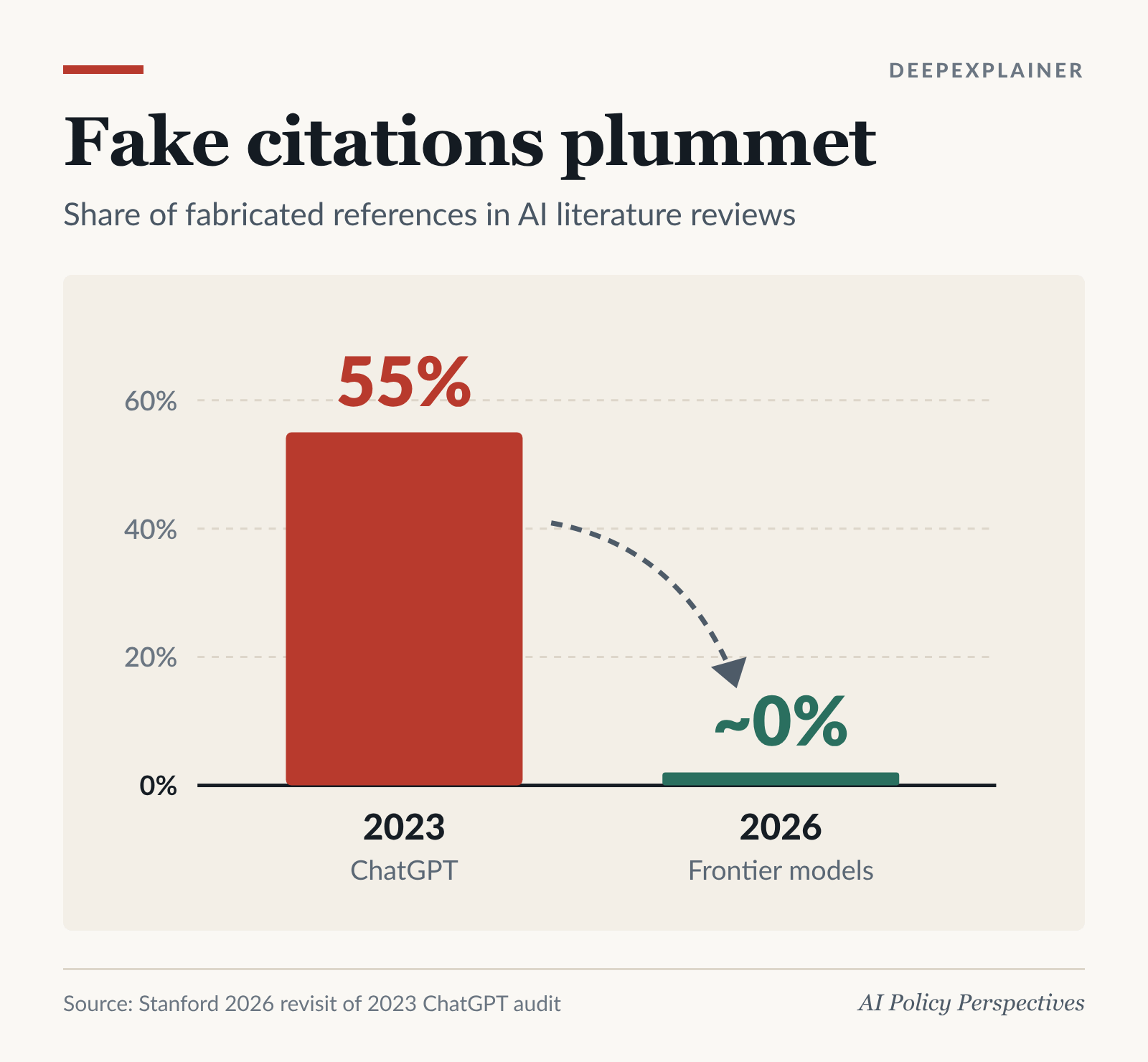
This echoed another recent study from Harvard scholars, which judged AI better than humans at reviewing academic articles. This was partly because more recent models had almost eradicated the risk of fabricated citations. (A recent audit of published works did find many fake references, but this was likely due to the ongoing use of older models.)
Despite the notable progress, the issue has not been solved. In particular, models still struggle in various situations, such as when there is a void of relevant information.
5. Should we care about AI telling “the truth”? Or just basing its claims in solid sources?
In conversation, people might complain of a chatbot not telling the truth. But establishing “the truth” is often a philosophical question, requiring an oracle whose authority people may dispute. Instead, researchers tend to consider hallucinations in terms of grounding and factuality.
Grounding—also described as “faithfulness” or “attribution”—refers to whether identifiable source material supports a model’s answer. A leading approach to grounding responses is Retrieval-Augmented Generation, or RAG, which connects an LLM to an external knowledge base—such as a company’s internal documents—or to the internet itself, via live web searches.
Factuality goes beyond evaluating if a claim is faithful to its source, and looks at whether a claim corresponds to the best available evidence about the world. By way of example, a purported quote from the French president might be grounded in a video transcript of his remarks at the Élysée Palace, but that the Élysée Palace is in Paris is a matter of factuality. The factuality of such claims is easy to evaluate. However, many claims are ambiguous, subjective, or dynamic, as when answering the question, “Do most people oppose the death penalty?”
A statement can be grounded but false, such as when propaganda outlets inject deliberate falsehoods into the information that RAG systems use. A statement can also be factual but ungrounded, such as when a model states a fact that it learned during its training, but without grounding this in identifiable sources.
The degree to which you prefer strict grounding over a model with more built-in knowledge depends on the use case. Employees querying an internal tool to understand their company’s vacation policy will want answers tied to the latest guidelines. An individual explaining photosynthesis to their child will want quick, targeted advice, not a merging of irrelevant links. The distinction is important because models can be optimized accordingly. This explains why smaller, specialized models sometimes outperform more capable reasoning models at strict summarization tasks, as reasoning models are more likely to extrapolate beyond the contents of a document.
6. People are using AI agents more nowadays, and reliable robots could be coming too. What do hallucinations look like in those forms?
First, let’s look at agents.
They pursue goals by planning, using external tools, and delegating tasks to subagents. An agent might fulfill its assignment yet hallucinate along the way. A case in point came in a recent evaluation, where an AI agent published an application to the Apple App Store as ordered, but had hallucinated a phone number on the application form, which the researchers only discovered when analyzing the agent’s logs. This presents the risk of agents inadvertently planting hallucinations that go undetected but that have consequences later.
Second, robots. Physical AI is progressing fast, advancing beyond traditional hard-coded systems that do repetitive industrial tasks in a cage, such as welding car doors over and over. Robots with AI brains become adaptable, allowing them to carry out a wider range of tasks, often by converting verbal instructions like, “Pick up the red cup!” directly into physical actions. This poses new hallucination risks.
Perceptual hallucinations may cause a robot to misidentify an object, person, or obstacle. In a self-driving vehicle or a surgical robot, the consequences could be critical. In multistep physical tasks, errors may cascade, with one mistake—say, hallucinating an open manhole where there is just a circular marking on the road—triggering a chain of compounding problems, with the robot altering its own environment to deal with nonexistent physical circumstances.
Intriguingly, hallucinations can also be useful in robotics. Researchers are developing world action models that learn from video and generate probabilistic predictions akin to hallucinations of how a robot’s actions might change its environment. From imagining possible futures, it may plan actions better.

7. Hallucinations are down, but not out. Can researchers reliably judge how “hallucinatory” any given model is?
Yes, though it’s challenging.
The standard measurement approach across AI development is benchmarks: using standardized sets of questions and tasks to compare models and track their progress.
The AA-Omniscience benchmark contains 3,000 specialist questions—such as asking about the precise amount of thermal energy released when a specific quantity of coal coke is burned—in domains ranging from law to medicine to finance. It’s a “closed book” exam, meaning that the models cannot search the web. A correct answer earns a score of 1. To punish guessing, each hallucination earns a score of -1, while an “I don’t know” is punished less severely, with a score of 0. In 2025, leading systems scored at or below zero out of 100. Now, they score in the 40s to 50s.
The FACTS Benchmark Suite examines factual recall, but also how well models ground their answers to source documents; how they integrate search results; and their ability to answer questions about images. The top score rose from 69% in late 2025 to almost 80% in November 2026, although models are lagging on questions about images.
One question is whether these evaluations are measuring the most important thing. Should they keep measuring the hallucination rate (the proportion of answers containing a hallucination)? Or should they focus on how often a model declines to answer? Should they measure calibration (whether a model’s expressed confidence actually tracks its accuracy) or consistency (whether the model gives the same answer each time it is asked, or when it is phrased differently)?
The benchmarks also have limitations, such as data leakage: if tests end up in training data, improved scores may be illusory and a poor guide to how a model may hallucinate in the wild1. Also, when benchmarks evaluate single prompt-and-respond interactions, they may miss behavior that emerges over lengthy conversations2.
Human reviewers, such as fact-checkers and domain experts, can provide further insights—for example, evaluating how models and agents perform on complex prompts, during long conversations, or in high-stakes edge cases. However, expert probing is expensive and won’t scale. Also, humans have their own flaws, often oblivious to subtle errors or swayed by confident prose. So, researchers increasingly use LLMs and agents to evaluate AI itself—for instance, dividing answers into individual claims, and searching the web for evidence to support or counter them. These approaches present a fresh challenge, which researchers face across the frontier: if you need AI to evaluate AI, then how do you evaluate the evaluators?
8. Why have AI hallucination rates dropped?
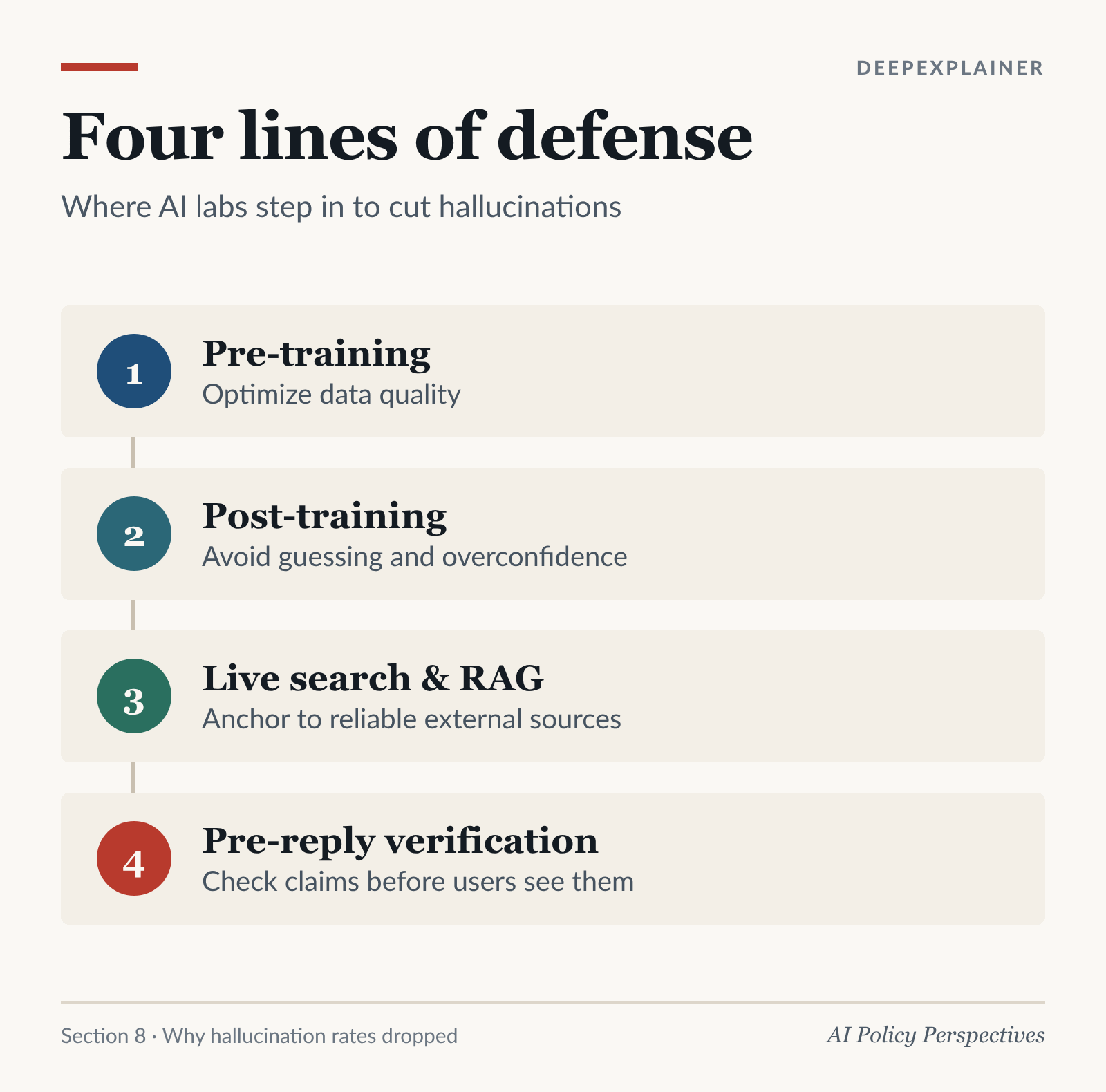
Researchers have implemented various mitigations.
At the pre-training stage, developers filter training data for errors or inconsistencies. Synthetic data can also be used to provide targeted examples that reinforce desired behavior. At the post-training stage, developers try to avoid rewarding models for guessing or for over-confidence with more targeted reinforcement learning to teach the model to optimize for factuality, grounding, or hedging when appropriate. AI labs are also developing their models’ character, infusing it with guiding principles, including honesty, that may reduce the tendency to fabricate.
Additionally, AI labs deploy mitigations during inference, when the model receives its prompts and prepares its output. RAG and tool-calling can be used to retrieve relevant documents, run search queries or query sources such as Data Commons, a massive library of public data. Developers can also design systems that intervene after a model has an output ready to share—but before it has actually done so. Approaches include using specialist AI models and agents to fact-check and verify another model’s output, or consensus sampling, which aggregates responses across multiple models.
All these mitigations come with limitations or trade-offs. Some research suggests that data filtering may be unnecessary or even unhelpful for powerful models that are more resistant to noise and better able to extract value out of messier data. Training and prompting a model to think step-by-step, and explain its reasoning before providing an answer, can force the model to avoid blurting out a plausible-sounding falsehood. But without access to external tools, this extra reasoning can also lead a model to better rationalize a guess. Agents that fact-check another model’s output need to be quick enough and cheap enough to run at scale in products.
9. Will we ever eliminate hallucinations?
Some researchers think not; others are hopeful.
The functioning of LLMs—predictions based on patterns in training data—could mean that developers can never totally eradicate hallucinations. Some thinkers suggest that the goal should instead be to minimize the impact—for instance, by teaching models to better quantify and communicate their uncertainty. Besides helping human users, that could help AI agents and robots know when to seek confirmation before acting.
There are several approaches to calculating uncertainty, from looking at how a model’s answers change when repeatedly prompted; to scrutinizing the model’s internal workings; to training a model to better clarify what a user wants. Besides this, LLMs (like all thoughtful communicators) should know when to hedge statements, and how to express their reasons for doing so—without becoming so pedantic as to leave audiences bemused as to what might be true.
Other researchers hope to remove hallucinations altogether. Some proponents of world models, which generate persistent, realistic 3D digital worlds, hope that this could provide models with a richer understanding of physical reality, including cause and effect.
The AI researcher Yoshua Bengio has proposed another approach: restructuring training data to separate objective facts from human claims, and training models to weigh competing claims. This, he argues, would create safer systems that operate more as scientists ideally do, evaluating evidence, rather than acting as reward-seeking agents.
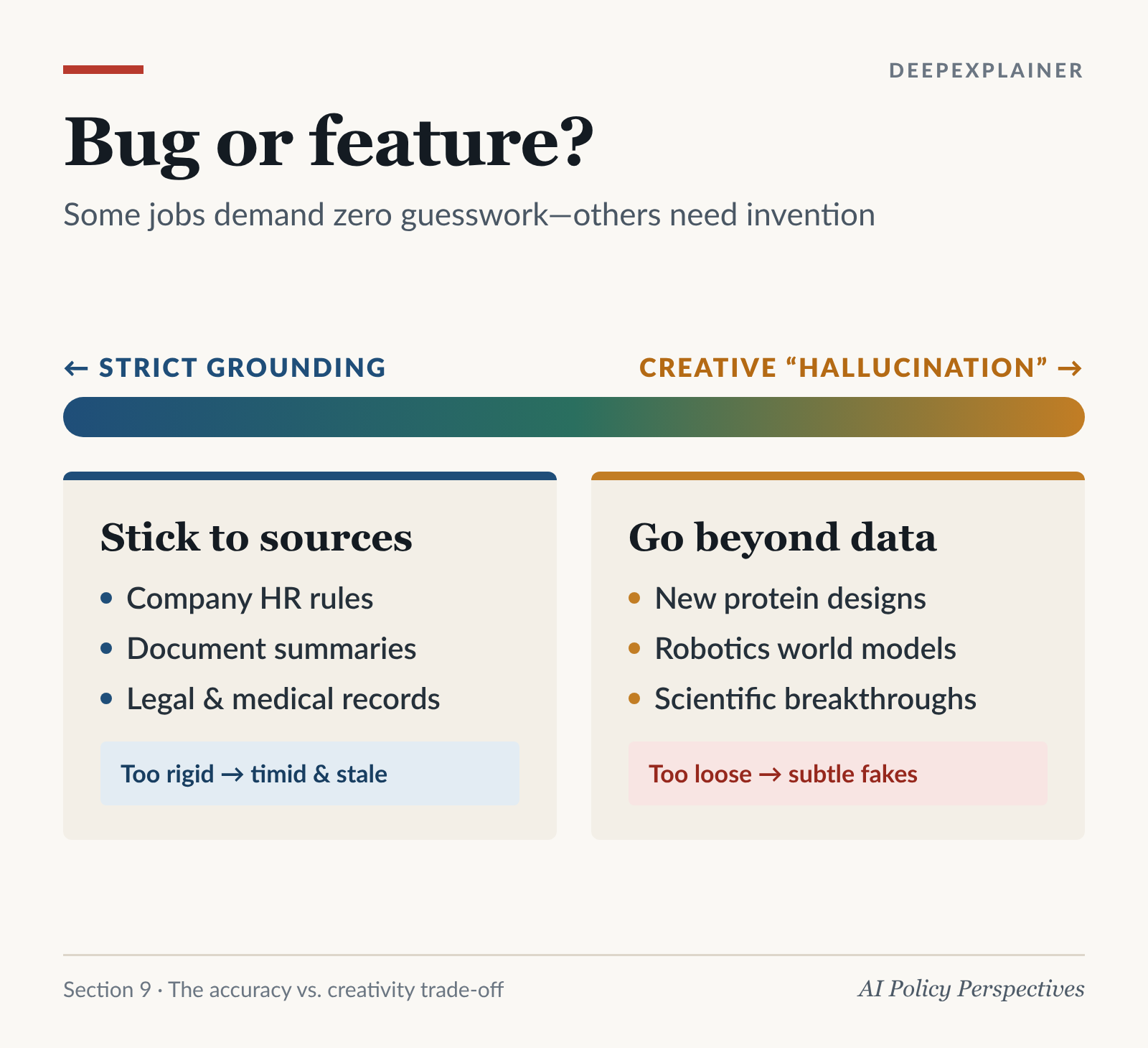
This said, we sometimes want models to hallucinate. While researchers often seek models that are more grounded to available evidence, efforts to mitigate hallucinations could cause AI models to stick too closely to their training data, repressing creativity, and leading to scientific hypotheses or product ideas that are conservative and homogeneous. In the field of protein design, “hallucination” describes the beneficial use of AI to generate new protein structures and sequences, from scratch. In robotics, world action models are useful precisely because they can generate something they have not observed.
Researchers working on AI scientific creativity are experimenting with systems able to go beyond their training data—much as the AlphaGo system famously did against the Go champion Lee Sedol. This could mean optimizing for hard-to-specify variables like surprise or counterintuitiveness.
If AI models become increasingly creative, one challenge will be ensuring they do not introduce sophisticated falsehoods that even seasoned experts might miss.
10. If AI hallucinates less, should we use it to reduce human mistakes?
To err is human, due to our limited working memories, inadequate training, and the myriad biases and daily pressures that we are subject to, among other factors. Misdiagnosis leads to an estimated 800,000 Americans dying or suffering serious disability every year. More than 10% of psychology papers include a mistake that is serious enough to change whether a finding counts as statistically significant.
As noted above [Question #4], scientists at Harvard recently found that AI reviews of research papers outperformed those by paid human experts on every measure they constructed, including accuracy. In response, the authors argued that banning the use of AI in peer review is increasingly counterproductive, and suggested ways for journals to carefully integrate it.
That said, most domains do not have evidence that AI would be more accurate than humans in realistic scenarios. Partly this is because most real-world situations require more than just accuracy. Even those Harvard scientists who support the integration of AI in article reviews warn that it could lead to a growing homogenization of research, and call for humans to remain in control of publication decisions.
Similarly, when a doctor carries out a consultation, or when a teacher instructs a class, the objective is not only informational accuracy, but also whether they can reassure and motivate. We also need accountability if things go wrong.
Some thinkers argue that AI will improve public information and decision-making; others fear it may undermine people’s capacity to form and revise their beliefs. Perhaps the best approach could be for AI and humans to catch each other’s mistakes.
The challenge of data leakage is why some benchmarks, like FACTS, maintain a private test set.
Recent research highlights why it is important to move beyond evaluating single queries and responses. The authors found that back-and-forth interactions can sway a model’s confidence in what they’re saying. When the model sees their own answers played back to them, they can become more confident and reluctant to change. Conversely, when presented with contradictory claims, they can overcorrect. Both behaviors exhibit poor calibration: the model’s confidence changes by more or less than the evidence warrants.
The 55 percent fake citation figure is the one that stays with me. I wrote about a never-list for AI tools at AI Edge, and the first rule on mine is that it never invents a number or a quote.