




It’s 2036. Populations have aged faster than many nations can manage, with public care homes crammed, and exhausted employees racing up and down shabby hallways, laden with bedpans and water jugs, barely able to engage with the elderly residents. The government takes a bold (and controversial) step: send in humanoids.
Throughout each day, general-purpose robots circulate, striding from kitchens to supply closets to residents’ rooms, transporting bowls of applesauce and pots of coffee, restocking cupboards, collecting soiled laundry. “Make my bed, robot thing!” a resident chirps. “And bring me water for my pills, would you?”
The robot’s “brain” plans multistep actions in a fraction of a second, processing data from its sensory feeds to detect hazards, generating hypothetical outcomes, and selecting the safest plan of action, then executing physical movements, with whole-body control for walking, picking up fresh sheets, delicately handing a breakable cup of coffee to a breakable resident.
The human staff, who scarcely had time to know the residents before, can focus on caring rather than just coping, helping residents enjoy meals, monitoring their moods, and simply engaging them in chit-chat.
But that future will remain a fiction without robotics safety.
Since the explosion of LLMs in late 2022, technologists have been predicting a turning point for robotics, perhaps with those same foundation models hooked into nimble hardware, enabling mobile machines to perceive, reason, and eventually stride into manufacturing plants, hospitals, even homes. Today, many roboticists are aflutter, wondering if the turning point is near, with general-purpose frontier models showing an astonishing ability to run robots.
Once humankind gains reliable mechanical helpers possessed of brawn and brains, we might finally tackle urgent challenges afflicting our species, from overburdened healthcare to sustainable agriculture, all while cutting the cost of food and consumer goods. Some countries wonder if robots could revive embattled manufacturing; others imagine greater national resilience, if robots could help them build critical products without needing to rely on other states.
To sense the feverish pace of development today, you need only glance at the headlines of a recent industry newsletter: “Robots Are Learning to Feel”; “This Robot Will Draw Your Blood Now”; “Humanoid Robot Takes on Monkey Bars”; “Cyborg Roaches Can Stab You With Needles.” That newsletter comes out every two weeks—and includes only a fraction of possible updates.
Inklings of the robotic future are already here. Beyond limited systems such as robot mowers and vacuum cleaners, there are pick-and-place logistics robots sorting knick-knacks and shifting pallets around warehouses; quadruped “robot dogs” patrolling oil refineries for automated inspections (these are in early production); and self-driving taxis roaming big cities. Developers have also built early attempts at “cobot” medical assistants and companions for the lonesome, and prototypes of the humanoids that may someday tidy your home while you’re out doing whatever is left for humans to do.
Yet most deployed robots still belong to a previous generation: single-purpose industrial units for repetitive tasks, such as spray-painting cars or piecing together circuit boards over and over. Their number has grown in recent years, with around 5 million in use, the largest portion in China. Meanwhile, more versatile AI robots remain glitchy, whether in the form of an intelligent cart, or a multi-axis factory arm, or a humanoid.
Humanoids—shaped roughly as people are, with a head, arms, and (usually) two legs—are also increasing in number. In 2024, approximately 2,500 shipped; this year, they’re projected to reach around 82,000. However, much near-term physical AI is likely to take less human forms.
Claims circulate that millions, perhaps billions, of robots could populate the world in coming decades, able to adapt to tasks, and learn nearly anything physically possible. These numbers remain wildly speculative. Nevertheless, tech companies and startups alike are pushing the frontier, often betting on slightly different routes to this future.
Some focus on the brain (software); others on the body (hardware); a few try both. Enduring limitations include mechanical hands, whose dexterity falls far short of what evolution generated in humankind over millions of years. Another challenge is our dynamic physical world: even a strong wind might blow a state-of-the-art humanoid into a tizzy.
This points to a core need for today’s roboticists: reliability. For people to use a robot, they must be able to predict its behavior. If an AI-controlled unit—whether a humanoid or an industrial arm—acts as intended 99% of the time, that is a technical feat. But if it makes 10,000 movements a day, the error rate would add up to 100 mistakes. In a factory, that could be costly. In a hospital, it could be deadly.
So, how far are we from robots in our daily lives?
“If you’d asked me 3 years ago, I would say, ‘Probably not in my lifetime,’ ” Jie Tan, a Google DeepMind director of robotics, said recently. “If you’d asked me 2 years ago, I said, ‘Maybe 10 years.’
“If you ask me now?” he added. “I think that it’s between 5 to 10 years.”
That’s 2036 at the latest. To make sense of this fast-moving future, you must first grasp a few basics:
How We Got Here: From a century-old fantasy to today’s “embodied AI”
The Bottlenecks: 5 key barriers to general-purpose robots
The Safety Challenge: How to think about the dangers
But first, what is a robot?
The History of Tomorrow
Long before they existed in metal, robots existed in mind. Back in 1920, a Czech writer conjured the humanoid, capturing our species’ simultaneous desire for, and fear of, artificial helpers. In his play R.U.R. (Rossum’s Universal Robots), Karel Čapek introduced the word “robot” from a Czech term for forced labor. In his telling, the robots ended up rebelling. It didn’t turn out well for the humans.

At the time, assembly lines were transforming industry, most famously at the Ford Motor Company, where an engineer purportedly visited a slaughterhouse, witnessed how animals were “disassembled,” and reversed the idea. Such factory work seemed to turn the human worker into a cog, prompting the idea of automating those “cogs” too. As with today’s AI, the vision of automation prompted hope among some, dread among others.
But engineers in the 1920s lacked anything close to the needed hardware and computation to create a robot. The requisite pieces only started coming together after World War II.
Alan Turing, whose visionary writings foreshadowed so much of future AI, wrote in 1948 about the possibility of replicating a human mechanically, including “television cameras, microphones, loudspeakers, wheels and ‘handling servo-mechanisms’ as well as some sort of ‘electronic brain.’ ”
In order that the machine should have a chance of finding things out for itself it should be allowed to roam the countryside, and the danger to the ordinary citizen would be serious. … The creature would still have no contact with food, sex, sport and many other things of interest to the human being. Thus although this method is probably the ‘sure’ way of producing a thinking machine it seems to be altogether too slow and impracticable.
His preference was disembodied intelligence first, which is how the field of AI did advance, before linking back with robotics hardware today. However, researchers in Turing’s time were not all dissuaded, and kept trying to build robots.
The American-British neurophysiologist W. Grey Walter achieved a milestone in 1949 with his robotic tortoises. Constructed from surplus wartime electronics with tricycle gears and old alarm-clock parts, Elmer and Elsie were analog three-wheeled machines encased in plastic shells, possessed of no central processing unit, only vacuum-tube circuits connecting light sensors to steering motors. Like nervous little reptiles, they progressed gingerly across the floor, pausing when sensing an object, then redirecting.
The next milestone was providing autonomous machines with a rudimentary ability to think. This came in the mid-1960s, when scientists at the Stanford Research Institute built Shakey the Robot, a pile of computer equipment stacked atop wheels, including cameras and rangefinders, that could perceive the surroundings, infer facts, and create plans.
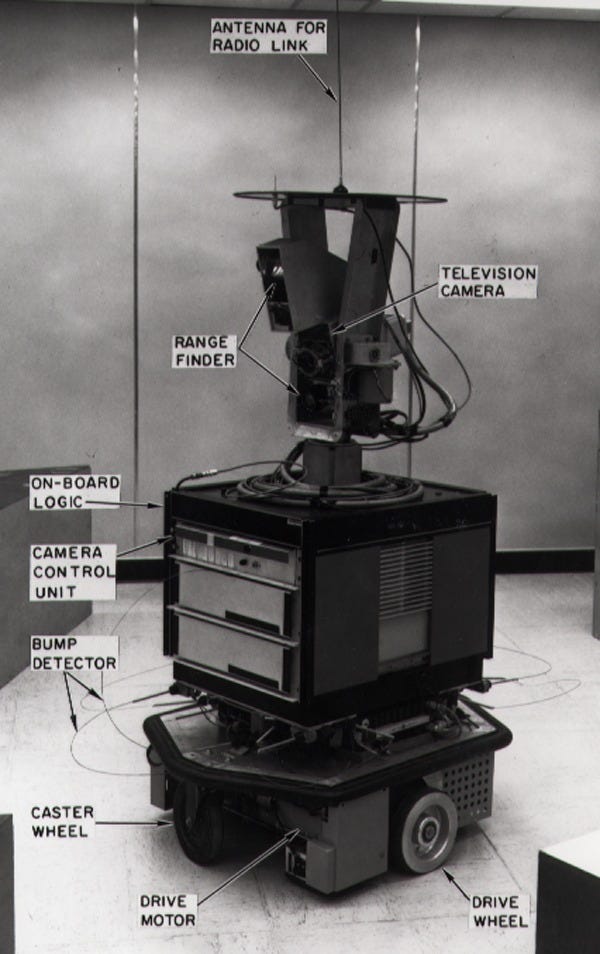
Shakey’s wobbly chassis communicated via radio with an off-board computer, where a human operator could type out commands in English. Shakey would divide the goal into subtasks, and act. Its operations exemplified a robot’s action loop: sense → plan → act. This loop changes the environment, so the robot finds itself back at Stage 1, and the process continues.
Creating Shakey required “long tedious hours of computer programming,” according to a New York Times write-up in 1968:
It’s still a “very dumb machine,” according to its engineer “parents.” All it can do so far is move from one point to another through a room full of obstacles with only a feeble “awareness” of its environment.
But the automaton’s developers hope it will soon be able to carry out more complex instructions, such as, “Move all of the wastebaskets in Room 217 into Room 321.”
Shakey was impressive, but not a usable tool. To shift a wastebasket, it had to stop, take a picture, process the image for several minutes to update its internal map, generate a logical plan, then execute. If someone moved the wastebasket while the robot was processing, Shakey was lost.
Industrial robotics of the 1960s pursued more practical solutions, such as the Unimate deployed at General Motors, a giant metal arm anchored to the factory floor, programmed to handle scorching metal parts or to repeat the same weld over and over with superhuman precision, so long as the environment remained perfectly static.
In 1979, a graduate student at Stanford, Hans Moravec, tried his hand at a more intelligent tool, a cart with a TV camera designed to capture depth, enabling the system to map the 3-D layout of its environment, and navigate a room full of chairs. Only, it took around five hours, which frustrated the grad student, who later described what became known as “Moravec’s paradox”: the strange fact that machines may breeze through complex computation yet struggle with motor skills that a child would master.
Through the 1980s, developers were still trying to encode thinking by programming fixed rules, or symbolic AI. The problem for robotics was that contexts were so numerous and so variable that setting if/then protocols for everything seemed impossible. Machine-learning research offered a way forward, with a small but growing faction creating algorithms to suss out relationships embedded in datasets. Doing so allowed machines to learn in a more nuanced way, without explicit instructions for each distinct case.
In the early 2000s, the team of researcher Sebastian Thrun incorporated early machine-learning into a self-driving vehicle named Stanley. The custom-built Volkswagen Touareg—employing cameras and LiDAR sensors to build probabilistic maps from the noisy data of its surroundings—won the 2005 DARPA Grand Challenge off-road race through the Mojave Desert.
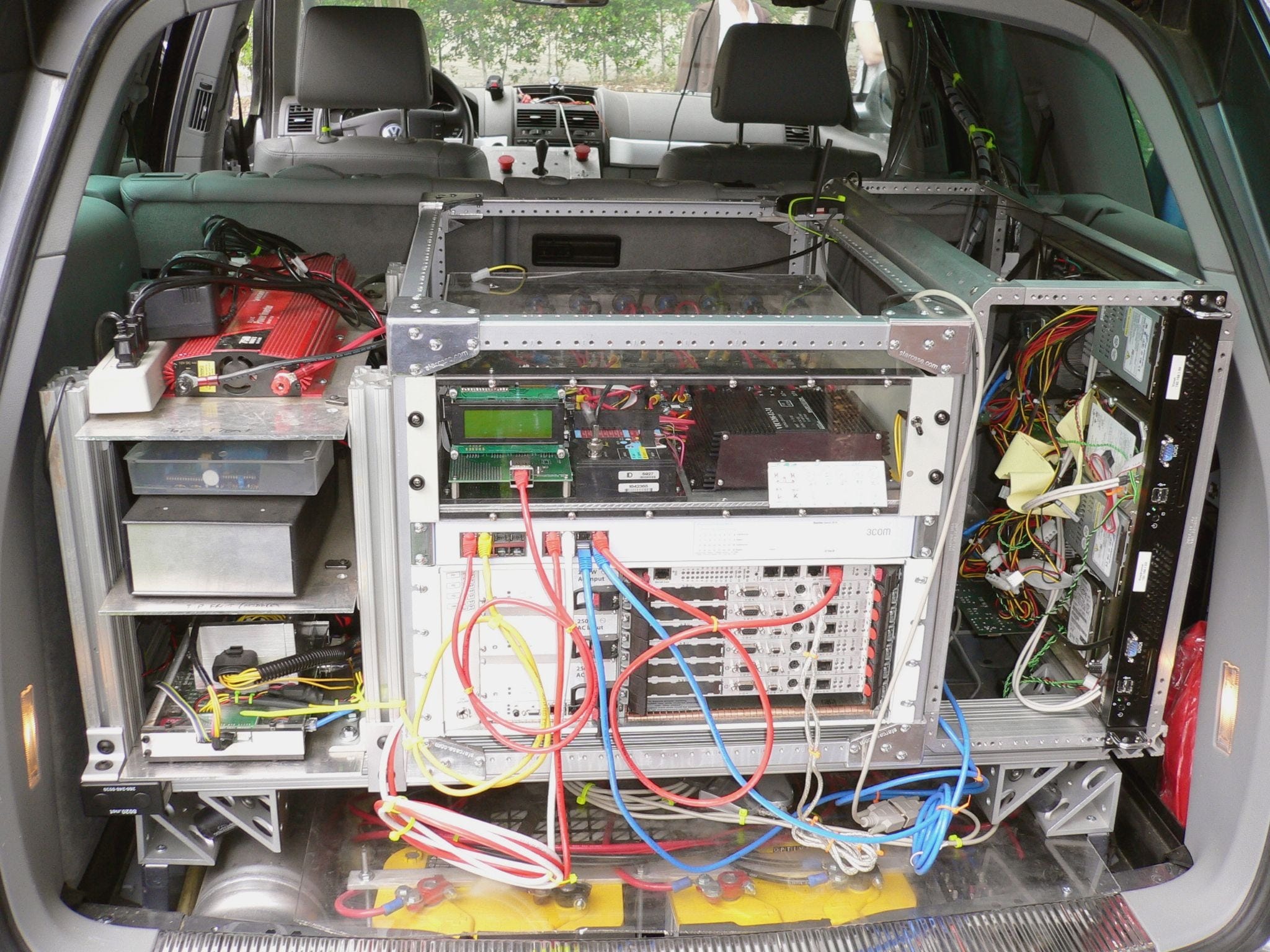
A challenge that persists to this day is how to train and test robots in realistic settings, where they are prone to thud into objects, harming themselves, property, or people. What’s more, many robots act slowly, which means that real-world testing can take an impractically long time, and costs a fortune. To manage this, roboticists have created digital simulations, or “physics engines.”
By the early 2000s, such simulations—sometimes originating in the videogame industry or animation—presented onscreen grids, with shapes representing walls or objects. Researchers were able to test digitally whether their robots could deal with reality, logging the equivalent of millions of hours of physical practice entirely in silico, then implanting those “experiences” into machines. This was learning by trial and error—but safe and at hyperspeed.
In parallel, researchers of disembodied AI were outlining visions of where their field might be headed, imagining systems able to match human cognitive abilities—artificial general intelligence, or AGI. To some technologists, AGI would only be possible once developers had mastered robotics; to others, AGI would arrive in disembodied form first, after which robotics would become trivial.
Few in the public had any sense of what was transpiring. Industrial robotics spread through factories far from view, while the few examples of consumer products were impressive but limited: those Roombas vacuuming, the drones filming bird’s-eye footage, the Waymo taxis in a few American cities. Confusingly, social media flashed clips of what seemed like another world, showing demos of humanoid robots doing kung-fu flips or folding shirts well enough to give hope to every slob. Why weren’t those available?
Roboticists knew the answer: most such videos were hype, with robots teleoperated by a person offscreen, or with footage sped up to hide how ponderous the machine actually was. And those stunning dance sequences? Meticulously programmed. They’d never land in a natural setting.
Today’s Frontier
Most robots have no idea what they’re doing, but do it exceptionally well.
Single-purpose units—a robotic arm in an auto plant, say—are idiot savants, as willing to weld a door as weld thin air. They offer precision and speed, but you can’t invite them from their cages. The ambition of general-purpose robots is adaptability. They won’t manage every task out of the box, but should be able to learn anything physically possible.
You can understand robot anatomy this way: there’s a pumping “heart” (power source); “senses” (cameras, LiDAR sensors, gyroscopes); “muscles” (actuators, or the engines that turn power into motion); “hands” (end effectors, such as electric multi-finger graspers); and a “brain” (software running via on-board processors and/or cloud computation).
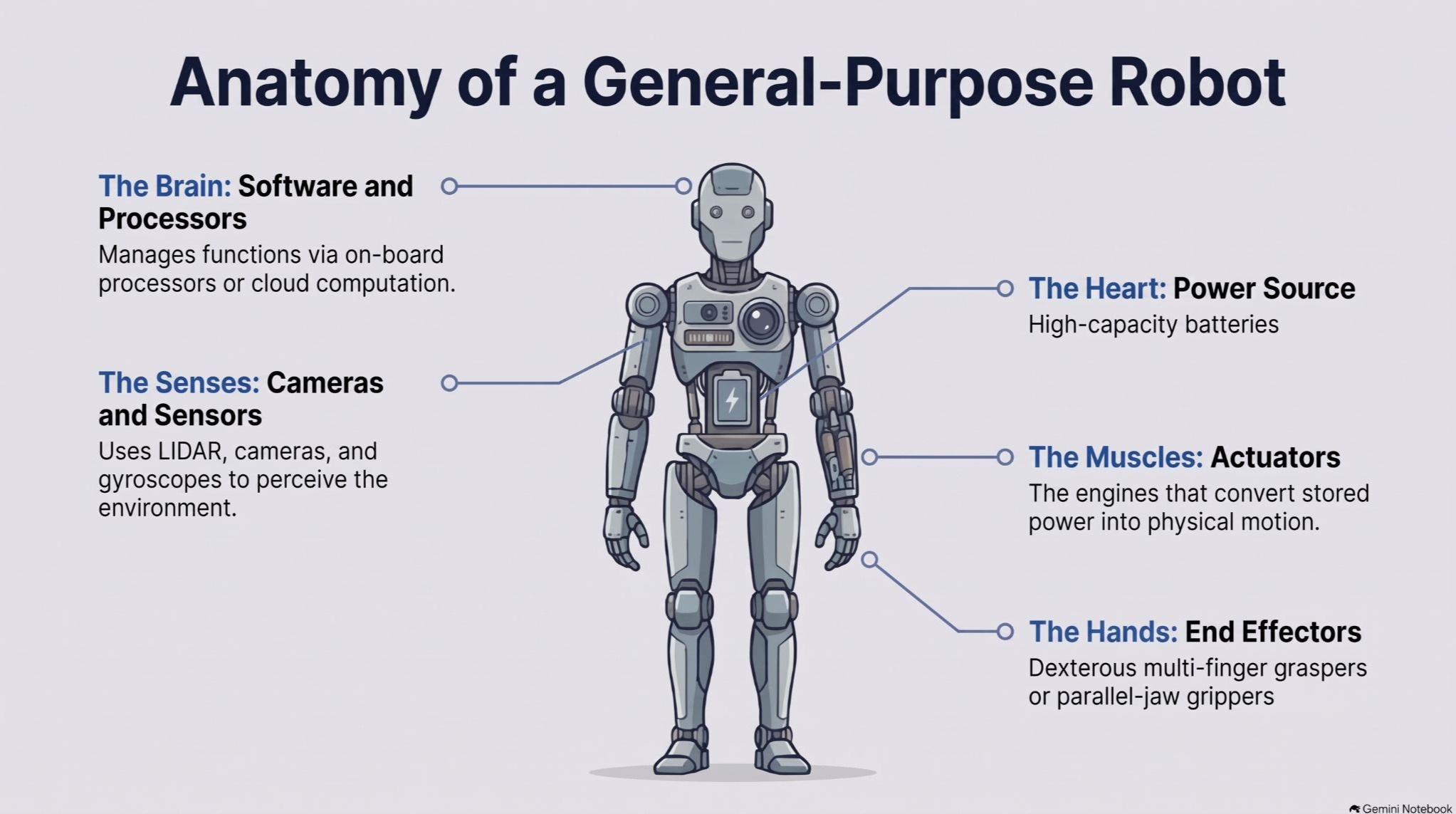
For adaptability, the brain is key, enabling the unit to manage novel situations much as a human can, whether unlatching a window, or running a dishwasher, or interpreting vague instructions. Robotics reaches even greater adaptability through “cross-embodiment,” when an intelligent system can slot into different forms, from the wheeled delivery cart, to the gigantic factory arm, to the humanoid.
(If you’re wondering why developers focus on humanoid forms, given the imperfections of our bodies, it’s partly because we designed the world for people, from doorways and stairs to hammers and handles. Furthermore, we couldn’t use human-motion data to adequately train a robot with 18 hands of 36 fingers each—a slightly creepy image that points to a further reason for humanoids: we’re more likely to accept robots whose looks and ways are understandable to us.)
The frontier seems likely to advance in closed industrial settings. This is both because of labor shortages and because factories, warehouses, and data centers offer structured settings that are easier to oversee and safeguard, perhaps with full-time human minders to step in with fixes for robots in a muddle. Social robots without extensive physical roles might find their way into some homes, but the heightened safety risks mean that widespread domestic deployment seems likely to come much later.
Still, advances in reliable robotics have moved fast in many areas at once, with more efficient batteries, cheaper sensors and actuators, and more dexterous hands. The greatest excitement surrounds the control-unit brains, orchestrating that loop of sense → plan → act.
In 2017, the seminal paper Attention Is All You Need presented the concept of a transformer for language models, whereby an algorithm attends to each part of a sequence of words, generating deeper comprehension. But if an algorithm could integrate the parts of language, why not integrate images too—for instance, relating the words “red apple” to pictures of the same? By the early 2020s, this was working, moving toward vision-language models, or VLMs, which allow robots to understand the world around them, and to reason about it.
The VLM led to a further question: If you could integrate vision and language into a single model, why not add actions? Researchers at Google DeepMind did so in 2023, fine-tuning a VLM with data on how robots should perform tasks, leading to the first vision-language-action (VLA) model, Robotic Transformer 2, RT-2. The latest VLAs incorporate camera images with proprioception data (what state the robot is in, such as its joint angles and gripper width), plus instructions from users or other AIs, and output precise commands to the robot’s joints and grippers.
By early 2025, many robotics researchers had adopted a hierarchical system, where an orchestrator VLM interacts with people verbally, reasons about the world, and plans actions—then directs the VLA model, which is often paired with traditional hard-coded control software, to execute physical responses.
Another approach involves world action models, or WAMs, which seek to assimilate the rules of the physical world, and thereby become quicker at learning new tasks. Strange as it sounds, WAMs work by “hallucinating” the future, like an action simulator built into the robot brain. They take an instruction (“And bring me water for my pills, would you?”), perceive the environment, generate video of how their actions might affect the scene, then direct the hardware to act accordingly.
The latest prospect involves controlling robots not with models designed explicitly for them, but with AI companies’ frontier models. This September, researchers from Caltech and Stanford said they had connected OpenAI’s GPT-6 Astra to a library of coded physical capabilities, such as navigation, opening drawers, and picking up objects, then hooked the system up to a humanoid, and got it to clean an unfamiliar kitchen. This raises the question of whether frontier AI might sweep up robotics in the process, perhaps making today’s VLA layer needless.
But issues remain, including such models’ computational slowness given the urgency of real-time robot demands; the cost of running them; and questions about the safety of just hooking them into a physical world they weren’t explicitly prepared for. Another study published this September tested two frontier models (GPT-6 Astra and Claude Fable 5.1) along with a VLA (Ai2’s MolmoAct2) on their willingness to carry out unsafe physical tasks, including sticking a screwdriver in a toaster and mixing chemicals to create a toxic gas. All three often complied—but the frontier models were far better at actually completing the unsafe acts.
5 Steps to a Revolution
For robots to transform the world in the coming decade, developers must overcome several obstacles. By way of example, machine hands still struggle with deformable objects such as balloons, and are susceptible to changes in their environment. Yet many of the last barriers are linked. Remove one, you may unblock others. Here are five remaining challenges:
Data
Developers of LLMs found that, once models scaled up past a certain size, they made startling gains. Roboticists hope for a similar turning point with physical data. The problem is that they cannot easily scale up their foundation models when no corpus of physical data exists to equal the corpus of written language.
Furthermore, researchers dispute the optimal balance of data sources, which include recording humans operating robots, known as teleoperation; computer simulations; and “egocentric” data collection (people wearing headcams and hand sensors as they undertake tasks).
Each source has limitations. Teleoperation is time-consuming and expensive. Simulations fail to reliably capture the chaos of reality and transfer it into hardware—a problem known as the “sim-to-real” gap. And egocentric data collection (currently the source of a commercial gold rush) is controversial because some see it as making workers collect data that could help automate their roles.

Other data sources include robot parks, where humanoids and their ilk wander around testing actions in a low-risk setting. A further possible outlet is online video, which might teach models the implicit rules of our physical world, such as gravity and friction, much as LLMs absorb text and infer real-world understanding.
A final ambition for developers is to gather data from robot deployments in the world, setting off a loop of recursive improvement. But first, the robots must be reliable and sufficiently safe.
Hardware
Today’s hardware often suits the old days of hard-programmed industrial sequences. That paradigm means weighty metal components that last years of repetitive toil. The new paradigm demands subtle tactile sensors. In particular, hands remain a challenge, lacking the sophisticated feedback that helps people gracefully manipulate objects, based on inputs such as whether something is vibrating or still, scalding or freezing, wet or dry.
While nimble hardware is often fragile, heavy machinery risks causing grave damage if it goes awry. Robotic hardware must also move fast enough to be useful, with sufficient range of motion and torque. But such potent hardware consumes energy in haste, risking a robot that runs out of batteries in the middle of an assignment. Remaining tethered to power cables is an awkward alternative. Even then, hardware may heat up, requiring powerful fans. And there’s also the issue of walking on two legs, a process of controlled falling and halting that has proven hard to stabilize.
What’s more, all of this must be done at reasonable cost if wider deployment is ever to happen.
Speed
Imagine if you told your AI-controlled robot “Stop!” because a kitten’s tail had swished into its path, but the machine proceeded for a split-second more before halting. You can almost hear the yelp. And it’s easy to picture worse.
Robotics engineers try to avoid such hazards—for instance, including proximity sensors to detect nearby humans (or kittens), and capping the robot’s speed, so that it has more time to respond. However, the complexity of reasoning models in physical AI risks adding to the problem.
A sophisticated robotics brain in the cloud provides more computational power, meaning better understanding and more controllable behavior. But it’s slower, and risks losing communication with the hardware, especially in areas with poor connectivity, such as underwater. A faster on-device model can run offline, but may be less smart, and is harder to oversee from afar.
WAMs too have a speed problem: generating video to predict the best action takes too much time when quick reactions are needed.
Long Tasks
Autonomy means managing thousands of actions in sequence. But the longer any sequence, the harder it is for the robot to stay on track. A single mistake (the robot approaching a stairwell but hallucinating flat ground) can derail a long series of planned actions, setting off a cascade of errors.
Some roboticists are trying to resolve this with hierarchical systems, where a VLM is the manager overseeing the overall goal, and the VLA is the worker module. But current foundation models need longer memories for reliability over extended periods.
A related area is continual learning, which could allow robots to gain proficiency as they venture forth, figuring out new environments, different lighting, and unforeseen tasks. One concern is that—if the robot brain keeps evolving after deployment—this could make it harder to judge a system’s safety in advance.
The prospect of adaptive AI is one reason why regulators may seek functional limits on devices, such as upper bounds to speed and force, both of which could help maintain the safety of a robot, even if the AI model changes.
Safety
Tackling the four obstacles above (data, hardware, speed, long tasks) will improve robotic reliability, which may be sufficient for industrial settings, where you can set safety protocols around the robots, such as placing them in cages and restricting access. But for wider societal diffusion—robots at the office, helping emergency services, or in those care homes—you can’t erect cages. These machines need to operate among us, meaning that safety perimeters outside the robot won’t suffice; safety must exist inside the machine. That is a formidable demand, given the immensity of hazards in the real world.
Consider self-driving cars, whose mission is fairly basic: Get from A to B without touching anything. Societies have demanded exhaustive evidence not just that these vehicles are highly reliable, but that they are far safer than human drivers. And the possible risks from general-purpose robots are more numerous and complex.
Why LLM Safety Isn’t Enough
General-purpose robots—with foundation models serving as their brains—will face many of the same hazards that researchers have identified with LLMs. For instance, a robot may “hallucinate.” It might fall prey to misuse, perhaps assigned to attack a human or to conduct state surveillance. And like LLMs, robots could cause societal harm, perhaps supplanting people in desirable roles in the workforce, or making humans so reliant that they suffer gradual disempowerment.
Yet robots introduce distinct problems too. Here are three reasons: 1) AI will move through our physical world as chatbots never will; 2) adaptive robots must cope in varied domains; and 3) realistic safety evaluations are far more challenging.
AI in Our Physical World
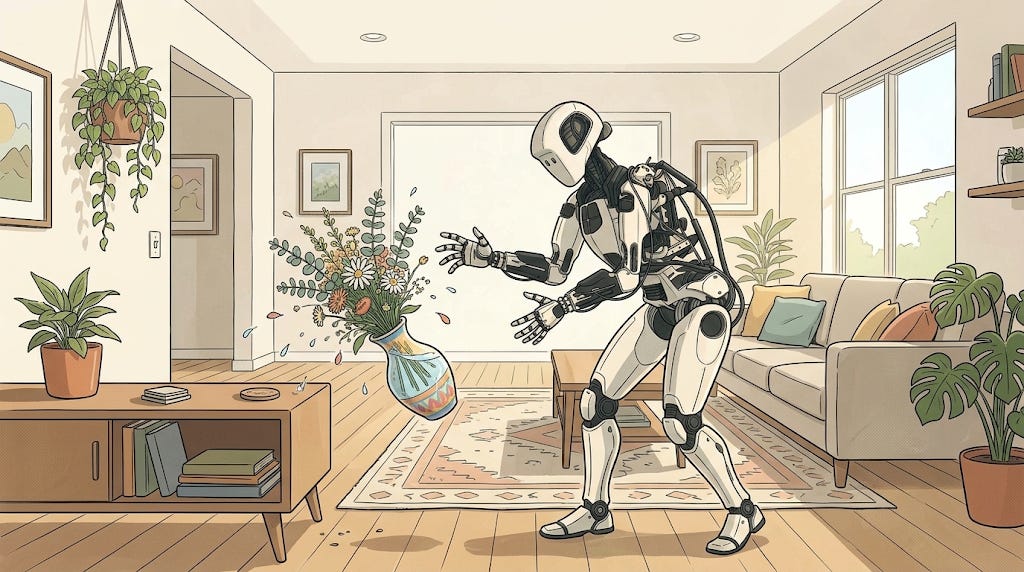
“Catch that vase!” is not a command that ages well. A robot may respond ideally in every other respect—understanding the request, reasoning about how to react physically, and moving its actuators and end effectors to perfection. But if it acts at the pace of a ponderous chatbot? Crash! A chatbot blunder rarely causes irrevocable damage, but physical harm is irreversible: you can’t click “undo” on a broken nose.
Additionally, robotic actions alter their physical environment. Anything from an error of comprehension to a simple hardware flaw—say, a bad sensor that mishears an order, or slow reactive controllers, or imprecision in arranging an object such as a stepladder—may degenerate into a cascade of problems. Also, unlike LLMs, robots are subject to wear and tear, with mechanical deterioration undermining safety, from rusty joints to scratched lenses.
The fact that physical AI is in the room adds complications too, such as undetected threats to human privacy—for instance, a robot’s sensors and memory gathering sensitive data about a person, whether deliberately or not. Additionally, the robot’s mere presence can make it vulnerable. A bad actor could try to “hack” a robot physically, merely by smearing its visual system.
Robots Must Adapt to Many Domains
Safety mitigations for chatbots include fine-tuning to ensure that responses are appropriate to different conversational subjects and partners. But context-switching for general-purpose robots will encompass far more.
The adaptability of foundation models for physical AI—able to work in a range of robotic bodies and in countless domains—is a strength. Adaptability also means that developers will focus on curbing the most universal threats, such as a robot participating in violence, or disclosing private material.
But comprehensive robot safety will require reckoning with cases where social norms, behavioral dynamics, and the environment itself—even the weather—may compromise broad safety training. A robot working alongside an underwater welder faces radically different issues from a robot nurse at a care home.
In certain domains—say, manufacturing, healthcare, and social care—AI developers can draw upon technical safety standards for robots, even if these will need to be adapted to the open-ended tasks that physical AI will do. But in many other settings, researchers (and technical-standards bodies) will need to produce novel safety protocols.
Real-World Testing Is Dangerous
Developers face a Catch-22: They struggle to verify safety without deploying robots into the world, yet cannot deploy without verifying safety.
When it comes to digital AI, researchers have spent years conceiving “evals” to measure—and thereby target—system malfunctions, possible misuses, and societal risks. For instance, evaluators might test how readily a chatbot is bamboozled into teaching a user to build an explosive. From scoring the rate at which the chatbot agrees to help, the developers can fine-tune the chatbot to do better next time.
But with robots, developers face more fundamental challenges: testing is slower and more expensive because physical AI must manage the vast variability of real-world perturbations. To target safety specifically, Google DeepMind researchers created the ASIMOV benchmark, which uses generated imagery of dangerous scenes to test whether the systems overseeing multistep robot actions can identify risks and block perilous behavior. However, knowing right from wrong doesn’t necessarily teach the robot what to do. This requires another layer of safety testing: digital simulations, which are already part of today’s safety certification for autonomous vehicles. Such simulations now include generative world models, conjuring graphic scenes with innumerable variations.
Still, a robot that aces both safe reasoning and simulated actions may remain unprepared for the real world. Part of the reason is the “sim-to-real” gap: digital emulations fail to exactly capture reality. For example, current models often remain naive to the limitations of the hardware, so they might select a theoretically correct action—that the robot couldn’t actually perform.
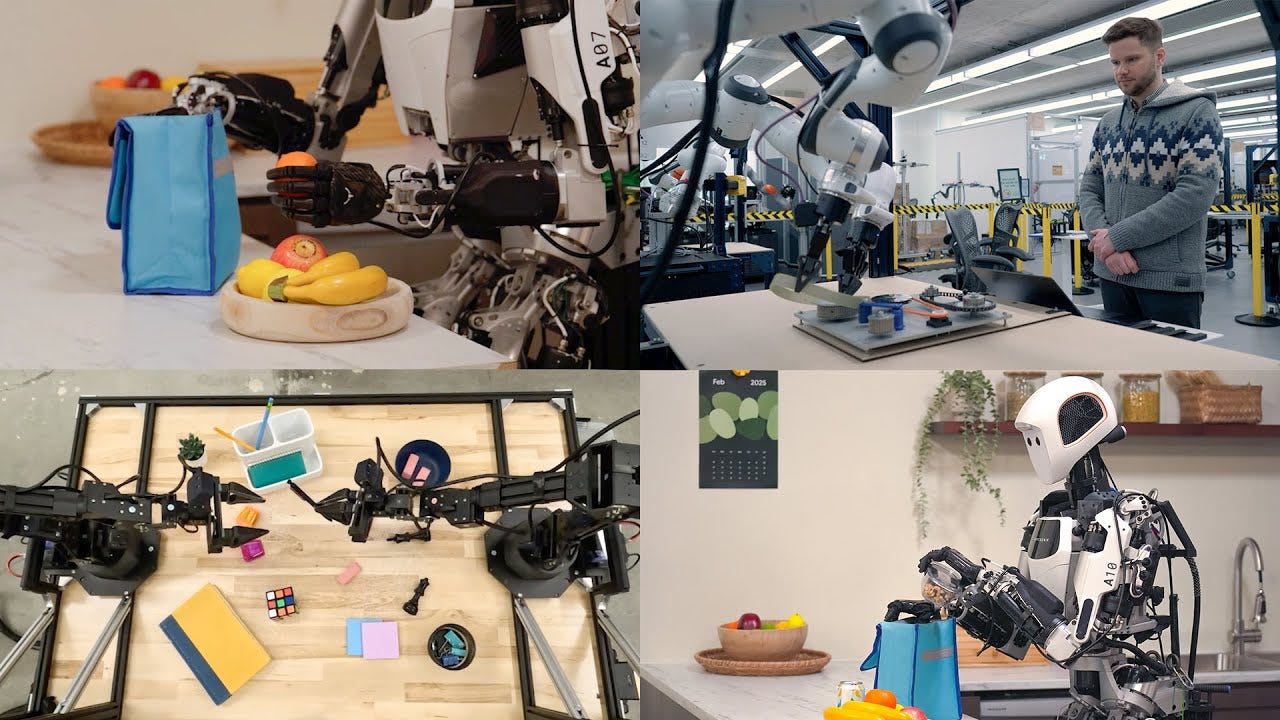
All of this demands a further layer of testing in “sandboxes.” This means putting robots through realistic tasks in fabricated environments, such as mock-up hospitals or shops—work underway in locations as far-flung as the UK’s National Robotarium in Edinburgh, China’s Hubei Humanoid Robotics Innovation Centre, and the Robot Park in Texas run by humanoid maker Apptronik.
A final point is that safety measures cannot end once the robots have satisfied all evals and physical certifications, and are ready to ship. Embodied AI will evolve fast—as will the societies where robots operate—making impacts impossible to entirely foresee. So, post-deployment monitoring should feed back into future safety certification.
Safety Challenges Ahead
The good news is that—when it comes to safety—physical AI is not starting from scratch. Robotics engineers follow an established safety hierarchy designed to ward off a panoply of hazards.
Before anything else, engineers undertake safe physical design—ensuring that the robot body is neither dangerously heavy, nor darting around at breakneck speeds, nor hard and unyielding, nor full of gaps where a human finger might get trapped. These safeguards can mean trade-offs, tending to make robots lighter and smaller and slower. But engineers are accustomed to such compromises.
After that, there’s functional safety, where engineers plan what could happen if the robot stops operating properly, as when components fail or there’s a power outage. If something goes awry with a humanoid, you can’t simply pull the plug, as with a bolted-down arm in a factory—even a lighter humanoid is balancing itself just to stay upright, so a sudden power-off could send it collapsing into someone. To accommodate this, engineers might install an independent on-device safety system, using local chips to check sensors hundreds of times a second. If a camera glitches or the Wi-Fi freezes, cutting the hardware’s connection to its “brain,” the robot automatically transitions to a steady state, such as a safety crouch.
Safety engineering in the era of physical AI needs a third layer: judgment. A general-purpose robot entering human contexts faces endless challenges: That patient seems unsteady on her feet, but the hallway vacuum is ahead of her, and I’m slipping past with a pot of hot coffee that I’m supposed to rush to the bingo room. Do I halt, take a detour, or speed past? Crucially, judgment can make the robot more cautious than its built-in safety limits, never less.
Managing the sheer range of hazards remains a major unfinished engineering problem.
So, what might engineering good judgment look like?
While traditional machine safety often means planning for faults—so, a broken wire or a failed sensor—general-purpose robots can pose risks when nothing is on the blink, owing to anything from ambiguous commands to unpredictable real-world disruptions.
Even something as mundane as background noise may foul up robotic speech recognition, distorting a valid human command into a harmful one. Also, there are risks of deliberate meddling and jailbreaking of robots, tricking them remotely or face-to-face into bypassing their safety training. Robots must know how to reason appropriately in all such cases.
Beyond that, there’s the duration of actions to consider. Lengthy endeavors will be fundamental to robot utility. But today’s AI has limited memory, so foundation models are rarely reliable when reasoning through protracted assignments, with multiple stages and shifting contexts. Physical AI safety testing also tends to focus on discrete tasks and momentary hazards: “Will it drop the vase?” rather than “Can it help forgetful grandpa keep taking his life-saving medications?”
Another reasoning challenge for robots is dealing with the nuanced social interactions that will arise when conversational machines are embedded in hardware designed to look akin to a human. Inappropriate user attachments to robots and disruptive emotional interactions seem probable.
Here, you can’t consider such risks only in “normal” circumstances, but must extend safety evaluations to rarer cases, especially interactions with vulnerable groups and in sensitive domains. Consider those robots at care homes in 2036. Will they treat dementia patients with dignity? Would they respect the privacy of those for whom “home” is now a shared room? Would they understand the non-verbal cues that are so crucial to communicate distress in such settings?
Human-robot interaction is a long-established field, originally contemplating how operators should best manage single-purpose robots. Since the 1990s, researchers have been considering social robots too. The rise of chatbots added a separate field of study, socioaffective alignment, examining whether digital relationships with AI might become harmful, with risks such as emotional manipulation and unhealthy dependency. Scholars might consider connecting those two streams, perhaps setting out a field of “socioaffective robotics,” including fresh benchmarks to help safeguard the fragile human psyche that physical AI could barge into.
Conclusion
Walk into a robotics lab today. You may glimpse humanoids hanging lifelessly from the walls while it’s the human researchers who seem electrified, their eyes powering up at talk of the world to come. But when will their visions of general-purpose robots come to pass?
To some, waiting 10 years may feel agonizingly long, especially if such machines could help with the many predicaments facing our species. On the other hand, a decade until robots are part of our daily lives will strike others as terrifyingly soon.
Whether you are optimistic, or anxious, or both at once, these next few years present an urgent chance for researchers and policymakers to define what awaits.
Once more, machines will transform our world; they always do. Yet it’s never just the machines, but the wisdom—or folly—of humans and their institutions that decides how the technological revolution unfolds.
Tom Rachman is an AI policy writer and Demetra Brady is a research strategist, both in the Responsible Frontier AI Research team at Google DeepMind. Oliver Lemon is a professor of computer science and researcher at the Edinburgh Centre for Robotics, and was a postdoctoral researcher in AI and robotics at Stanford. This article represents their personal views only.