


Nicklas Berild Lundblad looks out the window of his island home, glimpsing a twinkle on cold Swedish seas. Rarely does he gaze at length, for Lundblad is thinking. And thinking means writing.
After a career in tech policy, Lundblad is far from Silicon Valley yet near to silicon in thought, generating a stream of insights about our AI future, summoning everything from ancient philosophy, to enlightenment economics, to classic sci-fi.
Among his many superb essays (subscribe to his writing here) is the following adventure through time, in which he ponders the quickening of life that bedevils humanity today.
At AI Policy Perspectives, we read this essay months back. We’re still thinking about it.
—Tom Rachman, AI Policy Perspectives
By Nicklas Berild Lundblad
Technology transformed time. What humanity once experienced only through natural cycles—the rising and setting of the sun, the waxing and waning of seasons—has increasingly been mediated through interfaces.
Early civilizations relied on sundials, water clocks, and hourglasses—devices that measured time through natural phenomena, such as shadows or flowing water. These instruments divided the day into rough increments, sufficient for agricultural societies governed by seasonal rhythms.
This changed when the medieval monastery introduced the mechanical clock, as Lewis Mumford notes in Technics and Civilization (1934). Invented to regulate prayer schedules, these clocks transformed human consciousness by creating the concept of measured, abstract time. Mumford argues that the clock, rather than the steam engine, was the key machine of the industrial age, describing mechanical timepieces as “power-machinery whose ‘product’ is seconds and minutes.”
This technological production of chunked time allowed humans to coordinate activities, from labor in factories to scheduling trains. In his essay The Question Concerning Technology (1954), Heidegger argued that time became a resource to be exploited, from something we dwell within into something we track, manage, and consume—from private experience into public resource.
Since then, technological innovation has only accelerated human experience. The French philosopher Paul Virilio argued that this is the defining quality of modernity, with each technological revolution recalibrating our relationship to speed and time.
Consider how technology compressed distance: those time-consuming walks that gave way to galloping on horseback, which yielded to steam railways, then automobiles, and eventually supersonic flight. Communication followed a similar trajectory, from slow written letters to telegraphs, then telephones, and finally instant digital messages.
Judy Wajcman’s Pressed for Time (2015) challenges the idea that technology merely quickens everything. She argues that digital technologies provide interfaces that grant us more individual control over time Consider how your smartphone simultaneously creates time pressure (the expectation of immediate email responses) while offering new time flexibility (the ability to work from anywhere).
The German sociologist Hartmut Rosa imagines time as a three-layered system, consisting of 1) technological acceleration (faster transport, communication, and production); 2) social acceleration (more rapid turnover of institutions and relationships); and 3) life-pace acceleration (the compression of actions within smaller time-units). It’s not just that your phone is quicker than last year’s. It’s that the entire social world churns faster, forcing you to adapt by cramming more into each hour.
But Rosa observes something else that pertains to AI and time: certain aspects of life cannot be hastened. “To the contrary, many things slow down, like traffic in a traffic jam, while others stubbornly resist all attempts to make them go faster, like the common cold.”
Why do some things refuse to quicken? The answer is that we live in a world with two major forms of time.
Computers vs. biology
Imagine peering inside a computer chip. What you’d see is a race against distance itself.
Unlike the steady pendulum of a clock marking uniform intervals, computation involves signals that sprint between transistors. The dramatic acceleration of computing over the past decades stems to a large degree from one achievement: that we’ve made these signals run shorter and shorter races.
By shrinking the physical space between transistors from micrometers to nanometers—a 1,000-fold reduction—we slowly push computational processes toward the ultimate limit: the speed of light. We have also seen the introduction of new materials and new architectures. But the reason that a computational calculation that took hours in 1980 happens in microseconds today is largely the compression of space.
Biological processes work differently. A broken femur knits itself back together through stages that cannot be rushed: inflammation, soft callus formation, hard callus formation, bone remodeling. The nine months of human gestation contain a necessary sequence of developmental events, each building upon the last. Even our consciousness operates at speeds determined by neural transmission rates and biochemical cascades that have not changed since homo sapiens appeared. These processes may also slow down efforts to use AI to accelerate biology research, as to validate your AI model’s predictions in an experiment, you may still need to wait for DNA molecules to be cloned or for e-coli cells to divide.
The musical tempo of policy

The difference in time signatures has consequences, because human institutions mirror our biological constraints.
Consider justice and markets as pieces in society’s symphony, each with a natural tempo. Justice performs as a sostenuto—a slow, sustained movement requiring deliberate pacing and thoughtful development. Speed a sostenuto beyond recognition, and you destroy the qualities that define it. Markets perform as an accelerando, quickening naturally as they process information and reallocate resources. Forcing markets to play adagio often leads to stagnation and distortion.
The technological acceleration of our era tempts us to make everything as rapid as computation itself. We grow impatient with the tempo of democratic deliberation, ethical reflection, or meaningful relationship-building. We schedule our days in smaller increments, squeezing activities into time slots that barely accommodate them. We even grow frustrated with our bodies’ adherence to biological rhythms, needing roughly the same amount of sleep, recovery time, and digestive processing as our ancestors did millennia ago.
But what happens when we try to force institutions to operate at computational speeds? Imagine taking Bach’s Cello Suite No. 1—a piece whose profound beauty emerges through its deliberate unfolding—and speeding it up a thousandfold. At such speeds, the music wouldn’t just sound different; it would cease to be music at all, becoming an incomprehensible burst of noise. Similarly, justice compressed into microseconds is not quick justice—it’s no longer justice at all. Democracy conducted at processor speeds isn’t accelerated democracy—it’s something else entirely, stripped of the deliberation, reflection, and human connection that give it meaning.
We appear destined for increasing tension between the pace of silicon and the pace of humanity, with our institutions caught in the crossfire. But this conclusion misses something: artificial intelligence as a temporal mediator.
The great bifurcation of time

Consider what happens when you interact with a chatbot. Computational processes are operating at astronomical speeds—billions of operations per second—yet the interface doesn’t overwhelm you. Instead, it presents information at a pace you can metabolize, often mimicking human conversational rhythms. The AI serves as a step-down transformer, slowing the nanosecond world of computation into the second-by-second world of human cognition.
This mediation works both ways. When you step away from a conversation with an AI for hours or days, the system doesn’t experience this as waiting. It exists in a suspended state, ready to resume instantly when you return. This points to what may be the most significant sociotechnological transformation of the coming decades: the great bifurcation of time.
We are entering an era where computational time and biological time will increasingly decouple rather than collide. Instead of human institutions racing to match computational speeds—a race they cannot win—AI systems will negotiate between these temporal domains, allowing each to operate according to its rhythms.
Consider what this means for knowledge work. Rather than humans attempting to process information at computational speeds, AI systems will increasingly serve as asynchronous collaborators, working continuously through problems, then presenting solutions when the human is ready to engage. We already see this with deep-research modes in chat agents. The human provides direction, judgment, and values at a biological pace, while computation proceeds at electric speeds in parallel.
Financial markets hint at this bifurcation already. High-frequency trading algorithms operate at microsecond scales. Rather than forcing humans to operate at this speed (an impossibility), the market has bifurcated: algorithms interacting with algorithms at one timescale; human investors making decisions at another timescale, with AI systems mediating between these layers.
This will spread. Consider:
Healthcare: AI systems will continuously monitor vital signs and medical data at computational speeds while ingesting the latest research, then present insights to doctors and patients at human-comprehensible intervals
Education: Adaptive learning systems will analyze student performance at millisecond resolution while delivering personalized guidance at pedagogically appropriate paces
Governance: AI systems will process vast quantities of data at speeds no human could match, while presenting options to policymakers in formats that support thoughtful, ethical deliberation. These systems could even explore negotiated agreements at the same time, converging on possible equilibrium
Perhaps most significantly, this bifurcation will enable individualized relationships with time itself. When AI systems mediate our relationship with accelerating information flows, we gain the capacity to control our temporal experience.
Imagine an AI that shields you from the tyranny of immediate response, aggregating messages and information into batches, delivered at intervals you specify. Or consider how AI might let you engage with rapidly changing fields at your own pace, synthesizing developments while you’re away and presenting only what’s relevant when you return. No longer must you choose between staying current (racing to match computational speeds) and preserving your sanity (honoring biological rhythms). AI creates a third option: remaining connected while maintaining temporal autonomy.
Rather than technological acceleration forcing humans to keep up, AI creates the possibility of computational processes continuing their exponential speedup while human experience slows down. This might enable a renaissance of temporally appropriate activities: deep reading, contemplation, craftsmanship, relationship-building. We might witness the emergence of “slow thought” movements.
On the other hand, temporal bifurcation risks new inequalities between those who can afford AI mediation and those forced to race against computational speeds directly. It also raises questions about who controls the parameters of these temporal interfaces.
Just as learning to maneuver a car requires new physical techniques, working with temporal mediators will require learning new concepts and ideas and new ways of exercising our augmented agency.
Medic of the future
To imagine how this could work, think of a doctor’s diagnostic process. A decade ago, the doctor used a medical database to check symptoms. The doctor remained the orchestrator, with the computer merely a reference tool.
Now, imagine that doctor in the future, examining a patient with puzzling symptoms. Before the doctor asks her first question, the AI has already analyzed the patient’s electronic health record, identifying patterns across decades of medical history that might escape human notice.
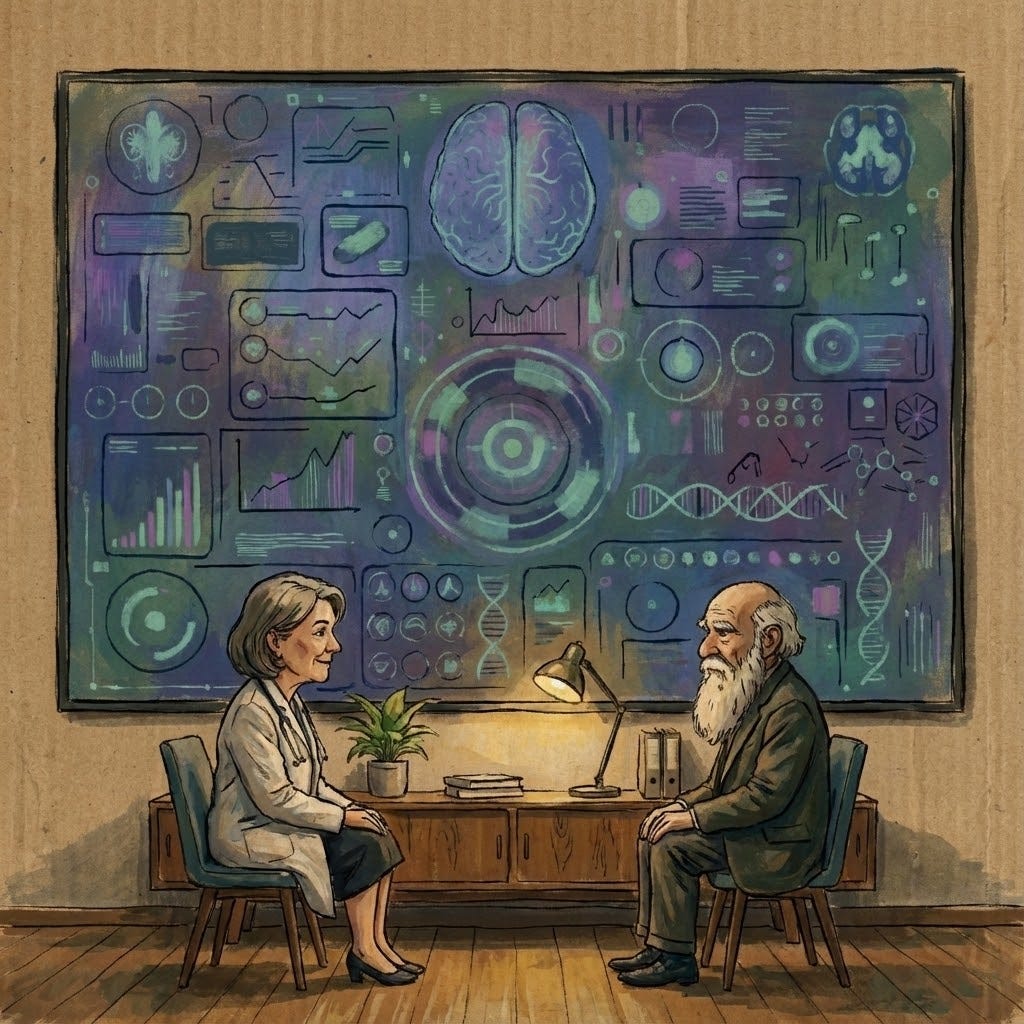
As the patient describes symptoms, natural language processing assesses subtle linguistic markers that might indicate depression, cognitive impairment, or pain levels the patient hasn’t mentioned. Simultaneously, the AI queries epidemiological databases to determine whether the symptoms match diseases in the patient’s geographic region or demographic group.
In parallel, the AI runs simulations of how different treatment protocols might interact with the patient’s existing medications and genetic profile as well as their personal life and circumstances. It cross-references the research papers published globally within the last 24 hours that might relate to the symptoms.
Analyzing a video feed of the consultation, it detects micro-expressions indicating patient anxiety about particular topics, flagging these for the doctor’s attention. And it compares this case against the doctor’s previous diagnostic patterns, identifying potential cognitive biases she may exhibit.
Each of these processes operates in computational time—milliseconds to seconds—while the human conversation unfolds over minutes. What’s remarkable is not just that these processes happen quickly, but that they happen simultaneously, in parallel temporal streams that would be impossible for a human mind to coordinate.
Yet the AI doesn’t flood her with the raw output. Instead, it performs a sophisticated form of mediation, determining which insights require attention and which can wait until natural breaks in the conversation. The system also translates statistical patterns into intuitive visualizations that the doctor can grasp quickly, while arranging information hierarchically, presenting the most relevant possibilities first.
The power of this temporal mediation becomes apparent when the doctor faces a critical decision. In the past, the fear of missing the serious diagnosis might have led to defensive medicine, ordering excessive tests just to be sure.
But as she contemplates her options now, the AI has already calculated the probability of each condition based on population data, regional epidemiology, and this patient’s profile; simulated the likely outcomes of different treatment paths, including risks, costs, and recovery trajectories; and generated a decision tree, highlighting key points where additional information would help narrow the diagnostic possibilities.
When the doctor absorbs this knowledge, she is engaging with what would have been months, or years, of sequential human research compressed into seconds—yet presented in a form that respects her need to process at a human pace. The AI doesn’t replace her clinical judgment; it expands what “judgment” encompasses.
The medical AI also allows the human to be fully present with her patient, maintaining eye contact, building rapport, observing subtle cues, because the AI handles the information processing that would otherwise compete for her attention.
This represents a major shift from first-generation digital tools. Early computers forced humans to adapt to them. Advanced AI systems adapt to us.
The Economics of Time
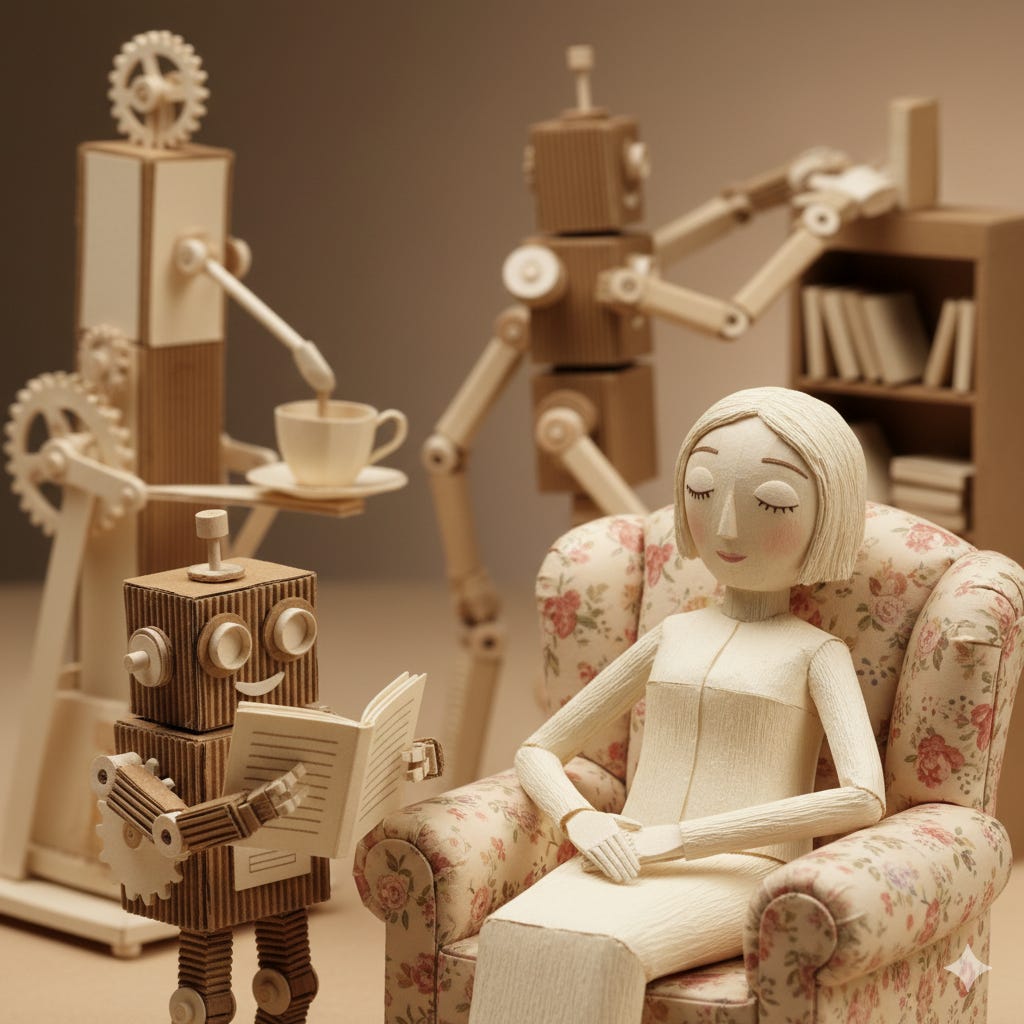
As AI systems mediate between computational and biological temporalities, we are also witnessing another bifurcation, between what we could call the judgment economy and the action economy.
The judgment economy includes activities that require human deliberation, ethical reasoning, and interpersonal wisdom—processes that resist acceleration because they are tied to our embodied experience as biological beings.
The action economy, by contrast, operates increasingly within computational time, gathering and processing information, implementing decisions, and optimizing systems. These activities can be dramatically accelerated because they can be reduced to algorithmic procedures.
Consider how this plays out:
Finance: Investment advisers operate in the judgment economy, understanding client goals, risk tolerance, and life circumstances, while trading systems operate in the action economy, executing transactions at microsecond speeds
Healthcare: Diagnosis spans both economies, with physicians exercising judgment while AI systems rapidly process test results, medical images, and research literature
Law: Attorneys formulate strategy and negotiate settlements in the judgment economy while AI reviews documents, does case research, and ensures regulatory compliance as part of the action economy.
These factors will reshape labor markets in ways that traditional automation narratives miss. Rather than simply replacing jobs, AI redistributes economic activity across the judgment-action divide. In the action economy, value increasingly derives from speed, scale, and precision—computational virtues that can be improved through technological advancement. In the judgment economy, value derives from discernment, creativity, and ethical reasoning.
When action becomes essentially instantaneous, the limiting factor in value creation becomes the quality of the decisions. In a world where anything can be done, what should be done becomes the essential question.
The bifurcation of economic time creates new forms of capital and, consequently, new dimensions of inequality:
Attention capital becomes increasingly precious. Those with the capacity to maintain high-quality attention toward decisions gain advantage in the judgment economy
Temporal autonomy emerges as a political good, the freedom to operate according to biological rhythms rather than being subjected to computational tempos
Judgment leverage becomes a source of outsized returns. The ability to pair high-quality judgment with high-speed computational action allows individuals to create value at unprecedented scales
For centuries, we have evaluated economic progress by productivity. But productivity belongs primarily to the action economy; it measures how efficiently we execute known processes.
In the judgment economy, the relevant metric is closer to discernment, the quality of decisions per unit of attention. This requires new economic indicators that value wisdom, foresight, and ethical reasoning, alongside efficiency and output.
Organizations that thrive in this bifurcated landscape will be those that balance biological and computational temporalities, accelerating action while creating protected space for judgment.
Judgment roles will be increasingly valued. Action tasks that can be fully specified, and do not require human judgment, will increasingly shift to computational systems. Hybrid roles will emerge at the boundaries—much work will involve standing between the two economies, requiring knowledge of both languages.
Also, temporal design becomes a core part of business. Organizations will need specialists who build appropriate temporal frameworks for different activities, knowing which processes benefit from acceleration and which require deliberate pacing.
Work evaluations will change too. Beyond simply measuring time-spent or output-produced, assessment will consider whether activities unfolded at the right pace for their purpose.
Societies that manage this schism between biology and computation will not only create material prosperity. They will foster human flourishing in bifurcated times.

Wonderful piece. Enjoyed the articulation between the judgment economy vs. the action economy.
I think there might be a messy transition towards that. Today one way of seeing the economy is above the API vs below the API. For example Uber drivers are below the API while corporate Uber jobs are above the API.
Over time the below-the-API jobs which are highly legible belong to the automated part of the economy
The question perhaps is: will we have sufficient job supply in the judgment economy above the API?
Benedict Anderson in Imagined Communities argued that the synchronicity of people reading the same daily newspaper was an important factor in the development of nationalism. He argued they experience themselves as part of a 'simultaneous community'. Lundblad's concept of AI as a temporal mediator is really thought provoking. If AI does allow for more choice about the tempo of your experience would that lead to new types of collective identity formation, or perhaps a fragmentation of collective identities?