


Guest post from Carl Miller, a technologist and writer based at the think tank Demos in London, and Beth Goldberg, head of R&D at Jigsaw, a Google technology incubator, who teaches at Yale.

Sun sparkled on the red double-deckers as busy Londoners hopped on and off, glancing at a poster as they went. Few understood its significance.
Behind a glass panel at the bus stop, the poster asked, ‘Who Cares About Care?’, above photographs of locals, and a QR code. What seemed a modest advertisement was actually part of a ground-breaking experiment that aims to transform how British local governments work by changing how they listen. This project could be a hint, and an inspiration, to governments around the world about how to transform themselves in the age of AI.
This question posed by Camden Council, which oversees a borough of north London, regards one of the key responsibilities of local governments in the United Kingdom: handling adult social care, which ranges from assisted-living homes, to mental health support, to nursing. Local officials, rather than simply convening a town-hall meeting to hear from whoever turned up, had established an online space where residents could state their priorities, and vote on the priorities of others.
But this project had resonance far beyond north London. For more than a decade—as many people came to suspect that technology just pulled societies apart—a scattering of digital activists, engineers, and academics were trying to deliver the opposite, employing artificial intelligence to detect common ground in the public, and root out policy choices that might unite people.
The long journey to ‘Who Cares About Care?’ started years before, and thousands of miles away.
‘BRIDGING’ TECHNOLOGY
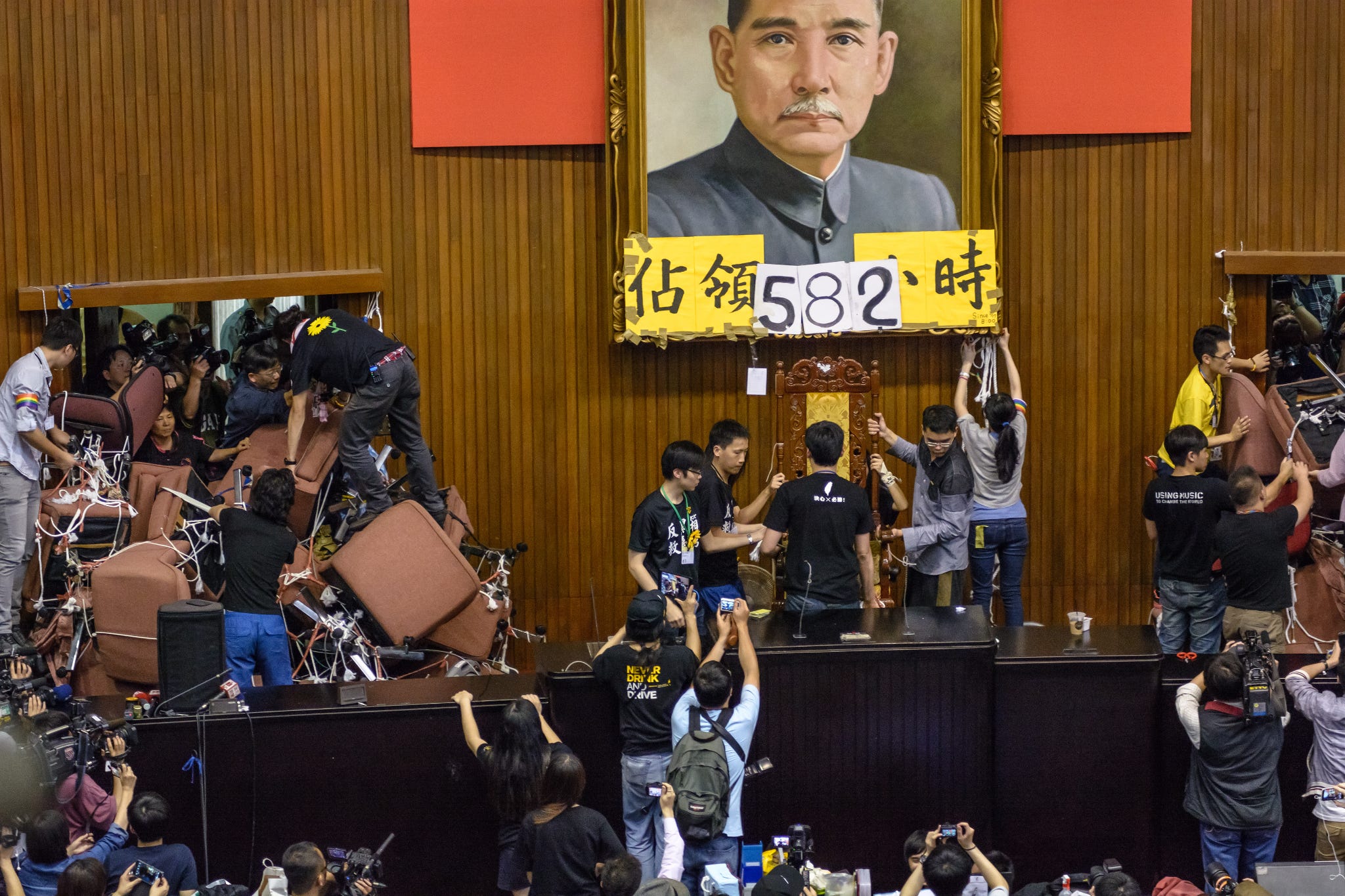
Taiwan’s Sunflower student movement of 2014 swept a new breed of politician into power: the civic hacker. Previously, civic hackers had existed on the margins of political life, trying to use technology to make officialdom more transparent and accountable. Riding a wave of disenchantment, they found themselves in government, and created an experiment called vTaiwan, which aimed to bring ordinary citizens into political decision-making.
Their insight was to see political conflicts, anger and polarisation as a problem of information. Old-fashioned arguments, they thought, failed to generate a clear signal to base decisions on, instead underscoring where people differed. What policymakers needed was a better way to find what people held in common.
Change the information circuitry, they thought, and you change the politics electrified by it. AI proved fundamental to that rewiring.
When facing a tense political debate, vTaiwan convened various civic groups on a public-deliberation platform called pol.is, where people could express hopes and fears, bugbears and hang-ups, and also hear comments from others, which they could thumbs-up or thumbs-down. The algorithm used ‘bridge-based ranking,’ which is one of the most important technologies that democracies need to evolve and survive.
How pol.is works is to integrate all proposals and votes that participants contribute, then locate each of those participants on an ideological map. Every cluster represents a tribe of sorts. Rather than serving up engaging content, bridging algorithms surface content that people from different ideological starting-points agree with, while blocking that which risks hardening group distinctions into long-running enmities The pol.is platform resembles an open forum like Reddit, where you can come anytime and add your comments and upvotes to an issue.
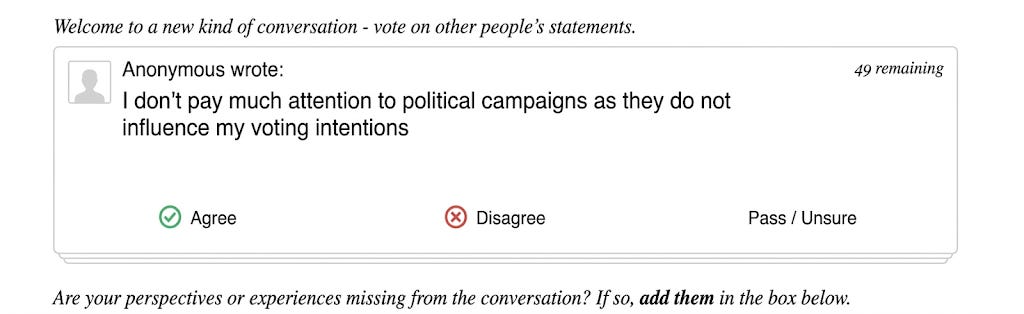
pol.is showed that the hope of Taiwan’s digital activists had been well-founded: if you rewire the information environment, you may find common ground that had been invisible. The process broke a deadlock on Uber regulation, and then a six-year impasse over the sale of alcohol online. It happened again with regulation over fintech, online gambling, cryptocurrency, and e-scooters.
Inspired by this success, others tested further ways to employ technology for constructive deliberation. Researchers at Google DeepMind trained an LLM to act as a mediator between people discussing divisive topics, and found it more effective than human mediators. They called it the Habermas Machine, after the great German theorist of the public square, Jurgen Habermas.
Another experiment with LLMs showed they could reduce belief in conspiracy theories by 20% via one-to-one interactions. Harvard’s Applied Social Media Lab built Frankly, a ‘video-based discourse platform’ for collective problem-solving that includes nudges to encourage people to speak, and clever ways of jumbling up participants during breakout sessions, along with techniques to gather proposed solutions as the conversation proceeds. Another platform is PSi, created to bring thousands of people into video-based online discussions, using AI to track polarisation and consensus in real-time.
Beyond using AI to find points of agreement, researchers have also developed technology for consensual decision-making. The Ethelo platform focussed on how to turn the last stage of any discussion into ‘convergence and closure’. Participants discuss possible options, weighing the importance of underlying issues—say, cost or time. An algorithm searches for the outcome that leaves everyone roughly equally happy. There are also tools such as Crownshy, which gathers open-source civic-tech tools, and strings them together into seamless workflows, so that policymakers can more easily procure and use them.
But are governments using these methods?
EARLY ADOPTERS

Nestled in the rolling pastures of southern Kentucky, the city of Bowling Green expects its population of 80,000 to double by the year 2050, owing to a strong job market that is attracting both locals and resettled refugees. This explosive growth has sparked a range of anxieties for residents and local leaders. Farmers worry about land preservation, educators about ballooning class sizes, and lifelong residents about the dilution of their small-town identity.
Bowling Green has a complex political makeup, home to a progressive university, a thriving refugee resettlement hub, and deep-rooted agricultural and industrial traditions, including the Corvette factory. This rapid population growth risks deepening cultural and political fault lines, though the community has thus far demonstrated pragmatic collaboration.
But inclusive conversations about managing this radical demographic change weren’t happening in traditional democratic fora. Town halls typically attracted fewer than a dozen participants, usually a non-representative sample of highly motivated detractors.
Bowling Green refused to be another story of the loudest voices setting outcomes for the rest. Instead, last year, the city ran what was then the largest digital town hall in American history.
How did the city leaders get nearly 8,000 residents to engage in this enormous question of what Bowling Green should look like in 25 years? The local government bypassed standard surveys or focus groups, instead working with pol.is (the deliberative platform used in Taiwan), along with Jigsaw (the Google incubator for social impact), the local lynchpin Innovation Engine and more than 100 community leaders, from the head of the library to the manager of the brewery, who served as local ‘listening partners’.
This diverse coalition jointly designed a campaign called ‘What Could BG Be?’ that engaged the public throughout the monthlong process. The campaign involved regional media agencies, community influencers, and grassroots leaders. Roughly 10 percent of the city contributed 4,000 distinct proposals and cast over a million votes, rewiring Bowling Green’s circuits for public engagement via AI-enabled dialogue.
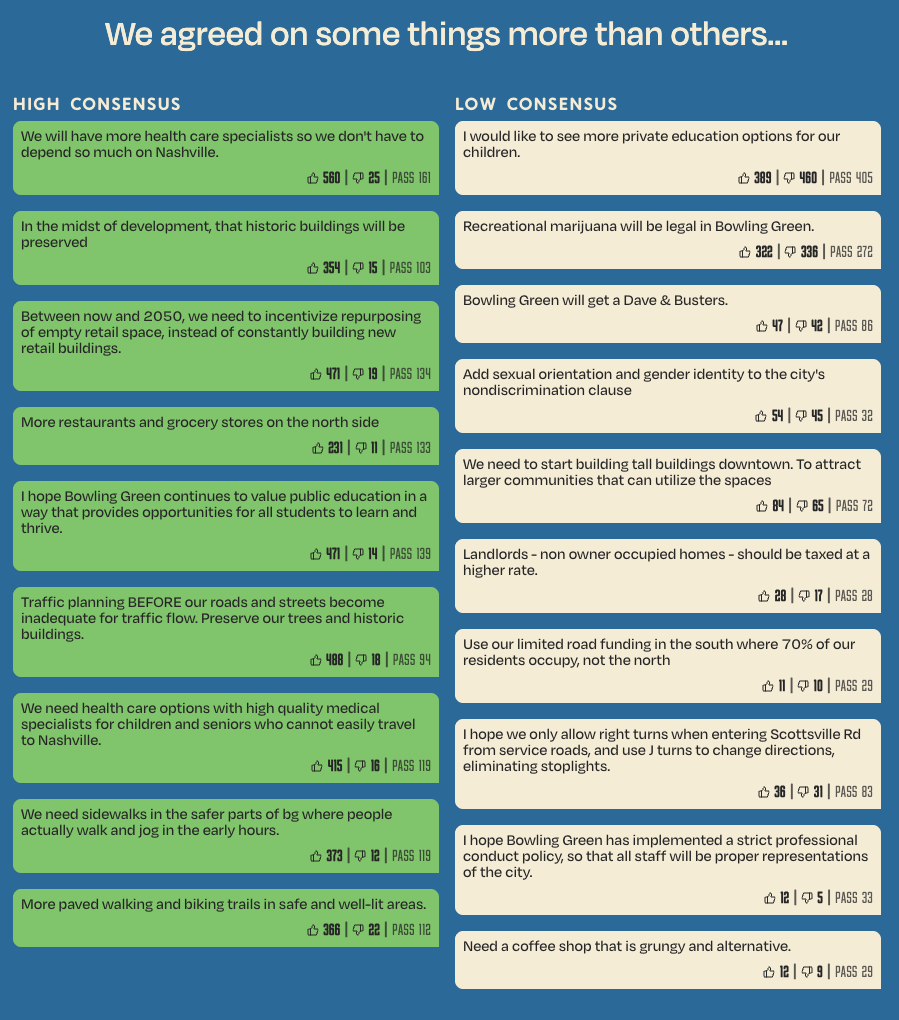
The organizers did not assume that digital access meant all were included, so they listened through ethnographic conversations across the community’s margins, engaging residents at refugee centers, halfway houses, rehab facilities, and senior living centres. By localising and translating outreach into nine major languages, they transformed personal experience into strategic civic engagement, allowing vulnerable groups, such as recentlydemo resettled Afghan refugees, to securely add their voices via a geofenced, anonymous platform.
The underlying bridge-based ranking algorithm prioritised points of hidden consensus rather than amplifying the friction typical of national political discourse. Specifically, Jigsaw’s Sensemaking— a suite of AI tools designed to help gather and understand public opinion—identified overwhelming nonpartisan support for practical initiatives, from synchronizing traffic lights on major arteries, to expanding eldercare, to developing community riverfront spaces. Ultimately, 96 percent of local leaders reported that the process had given them a more precise, actionable mandate to represent their constituents. When leaders use technology to deliberately listen rather than just broadcast, they may uncover surprising ways to act with broad-based support.
The British initiative similarly hoped to uncover unifying signals in the public. Like the Bowling Green invitations in coffee shops and churches to participate in a conversation about the future, that London bus-stop poster was an invitation to partake in a new kind of democratic governance.
The project, Waves—led by the British think-tank Demos, and including local governments—also uses bridge-based ranking. As in Taiwan, this was intended from the start to be more than a civic hackers’ dream but a process grounded in the realities of local government.
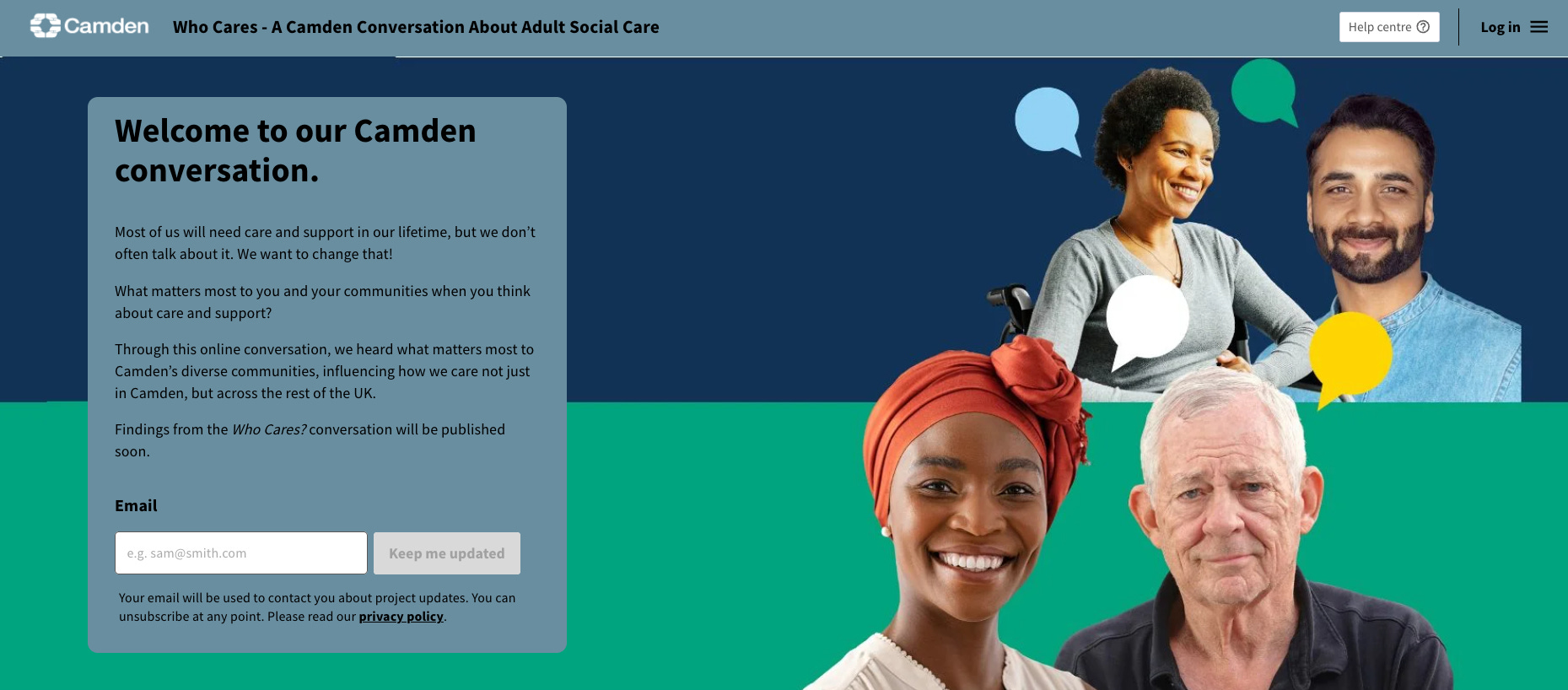
For six months, local officials joined technologists and think tankers to test and reshape every part of Waves. What they settled on was a process that starts by reaching as many residents as possible to understand the range of views about a question. The question that the Camden council asked locals was: ‘What matters most to you and your communities when you think about care and support?’
Then, Camden Council and the rest of the Waves team convened a much smaller but representative group of residents for a focussed discussion to turn those ideas into detailed proposals. These proposals were tested back at scale with the wider community, and what emerged was fed into a further phase of deeper deliberation where the group refined their conclusions. Finally, those conclusions were shared back with the wider community. The process moved in this way from a very wide process to a narrower and more focussed one, then back to a wide process, and then a narrow one. The process resembled a wave.
AI supports Waves in two main ways. During the ‘wide’ phases of public engagement, its main use is to get as many people into a single online space as possible, and then to use bridge-based ranking to reach consensus as emphatically as possible. During the ‘narrow’ stages of deliberation, the role of the tech is more subtle. Conversations are held over video chat, and tech helps facilitators spot emerging themes, synthesise insights across lots of conversations at once, and help to identify the priorities, decisions and actions these conversations identify.
The first phase of Who Cares? ran in September and October, and included more than 1,500 residents, 59% of whom had never taken part in a decision-making process in the local government before. From November to December, a panel of 41 Camden residents came together for 10 hours of discussion in the second phase. In January and February, the wide phase then reopened, with 550 residents sharing their thoughts on the priorities. The resident panel met again for a further 12 hours of discussion between February and March, reviewing considerations from Phase 3, trade-offs around funding, and finally establishing their expectations from Camden Council, the workforce, community, and individuals. As you read this, the council is reviewing those results. The next stages await.
Another deployment of Waves is now underway in South Staffordshire, in England’s West Midlands outside Birmingham, bringing together people to discuss planning policy and the thorny question of where new houses should be built. The longer-term ambition is to scale this up: to make digital democracy not only provably effective for local governments around the world, but also affordable.
If it works, these case studies will expand into dozens of deployments next year, expanding beyond local government into charities, unions, and other membership organisations that need to listen to large numbers of people, and turn their preferences into policy decisions. The ambition is to turn Waves into a flood.
But, after a decade of civic-tech experiments around the world, and a few bold attempts to apply them, the question is: Can AI make democracies stronger?

A RIDE TO THE FUTURE
The transformative power of civic tech—encouraging conversations, furnishing mediation, presenting politicians with better policy ideas—comes from identifying common ground among the public. But pilots and test-cases are one thing. To make a difference, such processes would need to become the norm.
Technology is going to be the easy part of democratic renewal. The question is whether political systems embrace these possibilities at scale.
If there’s one thing people dislike it’s a talking-shop, whether AI-mediated or not. People want agency, and that means being able to connect what they say to what is decided; and to connect what they agree upon to what is eventually done.
There are a number of reasons why connecting civic tech to power is difficult. The first is that it’s an act of direct democracy. This can sit uncomfortably alongside the idea of representative democracy, with politicians elected to make difficult decisions on the public’s behalf. What happens if a digital mandate produces an outcome that elected politicians feel violates their mandate? Which should take priority? For digital democracy to scale within political systems, we need clarity on how these different sources of legitimacy should interact.
Another challenge is public assurance—that is, gaining trust for these tools. Applying new technologies in government is also about transparency, cost and, especially when it comes to AI, ensuring that the process is safe, unbiased, and endorsed by a population that may be suspicious. This means impact assessments and compliance procedures, and other detailed processes to help local governments become familiar and comfortable with this.
Thankfully, AI can help with navigating new systems, both designing, testing and helping streamline the bureaucratic adoption. Furthermore, the relevant parties should be involved in designing their own new systems, helping assure that they are both informed and invested from the start. It’s time-consuming but invaluable.
The journey that began more than a decade ago in Taiwan, and passed through the rolling pastures of Kentucky and a bus stop in Camden, is only beginning. After years in which political systems seemed to be ripping themselves apart, trapped in rancour and mistrust, we should feel optimistic here. But it’s time to rewire the information systems on which politics operates.
Humans have more in common than we think. Sometimes, technology can help us rediscover that.
Carl Miller is a technologist and writer, founder of the Centre for the Analysis of Social Media at Demos and the information integrity lab CASM Technology. Beth Goldberg is the Head of R&D at Jigsaw, a Google incubator that builds technologies to give people greater agency, and teaches about AI at Yale’s Jackson School of Global Affairs.

Enjoyed this Carl. Bit of a personal angle though - you might recall this is more or less what I was doing with Represent.me from 2014-18. We got to about a million votes across 61 countries, 86.7% participation, and ran the Undivided campaign with it. Same year as vTaiwan, funnily enough.
The listening bit clearly works now, Bowling Green and Camden prove that. But I notice every example here is paid for by a council, a think tank or a Google incubator — and that's the part I'd push on. Whoever funds it holds the off-switch. Budgets get cut, Google kills products it's bored of, and a funder is least likely to keep paying at the exact moment the consensus turns awkward for them. So how much power are people really getting if the whole thing runs on the goodwill of the institutions they might need to push back against?
That's the problem we never cracked at Represent, and it's part of why we ran out of road. Genuinely curious whether anyone's solved the funding/ownership side, or whether it's still the elephant.
The safety/profit tension you're naming is real, but it might be narrower than it appears—the deeper issue is architectural dependency itself. When a single entity controls both the trust layer and the monetization layer, even well-intentioned leaders eventually face shareholder pressure to extract value from the relationship data they're custodian of. What if Grindr's users could own their social graph and run privacy checks peer-to-peer, the way Bitcoin nodes validate transactions without trusting a bank?